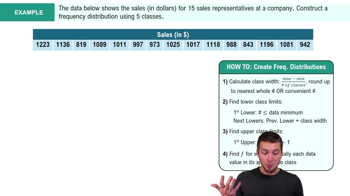
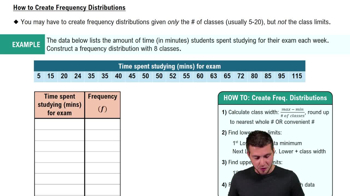
A frequency distribution is a table that organizes data values into classes and shows the number of measurements (frequency) in each class.
How do you calculate the class width for a frequency distribution?
Class width is calculated by subtracting the minimum value from the maximum value and dividing by the number of classes: (max - min) / number of classes.
What is the lower class limit in a frequency distribution?
The lower class limit is the smallest value that can belong to a class, typically the leftmost number in the class interval.
What is the upper class limit in a frequency distribution?
The upper class limit is the largest value that can belong to a class, typically the rightmost number in the class interval.
How do you find the class midpoint?
The class midpoint is found by averaging the lower and upper class limits: (lower limit + upper limit) / 2.
Why do class intervals in a frequency distribution not overlap?
Class intervals do not overlap to ensure that each data value fits into only one class and is not double-counted.
How do you determine the next lower class limit after the first one?
Add the class width to the previous lower class limit to get the next lower class limit.
How do you determine the upper class limit for a class?
Subtract one from the next lower class limit to get the upper class limit for the current class.
What is the formula for relative frequency?
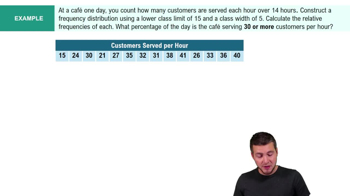
Relative frequency is calculated as the class frequency divided by the total number of measurements (f/n), often expressed as a percentage.
Why might you round up the class width when calculating it?
You round up the class width to avoid awkward decimals and to ensure all data values are included in the classes.
What is the purpose of a relative frequency distribution?
A relative frequency distribution shows the proportion or percentage of data values in each class, providing a clearer understanding of data distribution.
What variable is commonly used to represent the total number of measurements in a data set?
The variable 'n' is commonly used to represent the total number of measurements.
What is the risk of incorrectly calculating class width as upper limit minus lower limit within a class?
Doing so gives the range of the class, not the class width, and can result in overlapping classes and double-counting data values.
What is the first step in constructing a frequency distribution when classes are not given?
The first step is to calculate the class width using the formula (max - min) / number of classes.
How do you tally frequencies for each class in a frequency distribution?
Go through the data set and count how many values fall into each class, using tally marks or another method to avoid double-counting.
 Back
Back


 06:19
06:19