Skip to main content
Statistics for Business
My Course
Learn
Exam Prep
AI Tutor
Study Guides
Flashcards
Explore
Try the app
My Course
Learn
Exam Prep
AI Tutor
Study Guides
Flashcards
Explore
Try the app
Back
Frequency Polygons definitions
You can tap to flip the card.
Frequency Polygon
You can tap to flip the card.
👆
Frequency Polygon
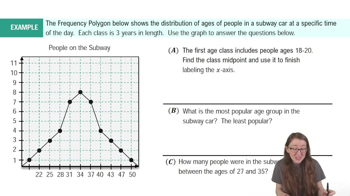
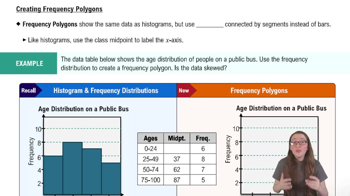
A graph using points connected by segments to display frequencies across classes, offering an alternative to histograms.
Track progress
Control buttons has been changed to "navigation" mode.
1/14
Related flashcards
Related practice
Recommended videos
Frequency Polygons quiz
Frequency Polygons
15 Terms
Frequency Polygons
2. Describing Data with Tables and Graphs
10 problems
Topic
Dot Plots
2. Describing Data with Tables and Graphs
10 problems
Topic
Ally
2. Describing Data with Tables and Graphs
10 topics
15 problems
Chapter
David-Paige
Guided course
04:41
Creating Frequency Polygons
309
views
5
rank
Guided course
04:15
Example 1
222
views
10
rank
Terms in this set (14)
Hide definitions
Frequency Polygon
A graph using points connected by segments to display frequencies across classes, offering an alternative to histograms.
Histogram
A bar graph representing frequencies for class intervals, with bar heights showing the frequency of each class.
Frequency Distribution
A summary table showing how data values are distributed across different classes or intervals.
Class Midpoint
A value found by averaging the lower and upper limits of a class, used as the x-coordinate for plotting.
Class Interval
A range of values grouped together in a frequency distribution, often defined by lower and upper limits.
Lower Limit
The smallest value included in a class interval, marking its starting boundary.
Upper Limit
The largest value included in a class interval, marking its ending boundary.
Y-Axis
The vertical axis on a graph, representing frequencies in both histograms and frequency polygons.
X-Axis
The horizontal axis on a graph, labeled with class midpoints for frequency polygons and histograms.
Skew
A measure of asymmetry in a distribution, identified by the direction and length of the tails relative to the peak.
Peak
The highest point on a frequency polygon or histogram, indicating the class with the greatest frequency.
Tail
The extended part of a distribution on either side of the peak, used to assess skewness.
Segment
A straight line connecting two plotted points on a frequency polygon, forming its shape.
Line Graph
A graph connecting data points to show trends over time, often confused with frequency polygons but used differently.
 BackBack

 04:41
04:41