Skip to main content
Statistics for Business
My Course
Learn
Exam Prep
AI Tutor
Study Guides
Flashcards
Explore
Try the app
My Course
Learn
Exam Prep
AI Tutor
Study Guides
Flashcards
Explore
Try the app
Back
Homogeneity Tests definitions
You can tap to flip the card.
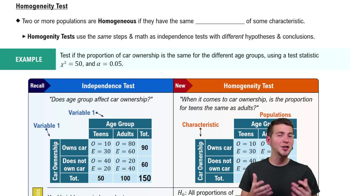
Homogeneity Test
You can tap to flip the card.
👆
Homogeneity Test
Statistical procedure comparing proportions of a characteristic across multiple populations to assess if they are equal.
Track progress
Control buttons has been changed to "navigation" mode.
1/14
Related flashcards
Related practice
Recommended videos
Homogeneity Tests quiz
Homogeneity Tests
15 Terms
13. Chi-Square Tests & Goodness of Fit
3 topics
15 problems
Chapter
Brendan
Guided course
06:28
Homogeneity Test Example 1
92
views
1
rank
Guided course
05:27
Homogeneity Test
101
views
Terms in this set (14)
Hide definitions
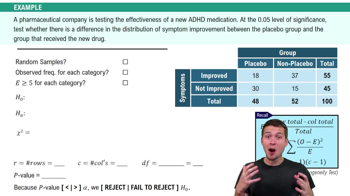
Homogeneity Test
Statistical procedure comparing proportions of a characteristic across multiple populations to assess if they are equal.
Independence Test
Statistical method examining whether two variables are related or affect each other within a contingency table.
Null Hypothesis
Default assumption stating that proportions of a characteristic are equal across all populations being compared.
Alternative Hypothesis
Statement suggesting that at least one population's proportion of a characteristic differs from the others.
Chi-Square Statistic
Numerical value calculated from observed and expected frequencies to measure discrepancy between them.
Observed Frequency
Actual count of occurrences for each category in the collected data.
Expected Frequency
Calculated count predicting how many occurrences should appear in each category if the null hypothesis is true.
Contingency Table
Grid organizing data into categories for two variables, displaying observed and expected frequencies.
Degrees of Freedom
Value determined by the number of categories, used to interpret the chi-square statistic.
P-Value
Probability of observing a test statistic as extreme as, or more extreme than, the one calculated, assuming the null hypothesis is true.
Alpha
Threshold probability used to decide whether to reject the null hypothesis, often set at 0.05.
Random Sample
Subset of data selected so that every member of the population has an equal chance of inclusion.
Proportion
Fraction or percentage representing the part of a population with a specific characteristic.
Characteristic
Specific attribute or trait, such as car ownership, being compared across populations.
 BackBack
 06:28
06:28