Skip to main content
Statistics for Business
My Course
Learn
Exam Prep
AI Tutor
Study Guides
Flashcards
Explore
Try the app
My Course
Learn
Exam Prep
AI Tutor
Study Guides
Flashcards
Explore
Try the app
Back
Inferences for Slope definitions
You can tap to flip the card.
Regression Line
You can tap to flip the card.
👆
Regression Line
A straight path that best fits the data points, showing the relationship between two quantitative variables.
Track progress
Control buttons has been changed to "navigation" mode.
1/15
Related flashcards
Related practice
Recommended videos
Inferences for Slope quiz
Inferences for Slope
15 Terms
12. Regression
4 topics
15 problems
Chapter
Ally
Guided course
02:59
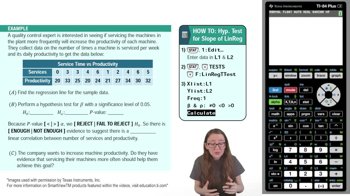
Hypothesis Test for the Slope of a Regression Line Example 2
71
views
Guided course
03:12
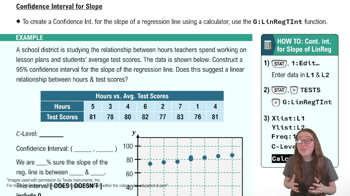
Confidence Interval for the Slope of a Regression Line
100
views
Guided course
04:13
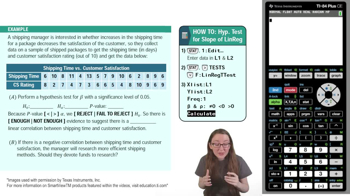
Hypothesis Test for the Slope of a Regression Line Example 3
71
views
Terms in this set (15)
Hide definitions
Regression Line
A straight path that best fits the data points, showing the relationship between two quantitative variables.
Slope
A value indicating the rate of change in the response variable for each unit increase in the explanatory variable.
Population Regression Line
The true underlying linear relationship between variables for an entire group, not just a sample.
Linear Correlation
A consistent, straight-line association between two variables, where changes in one predict changes in the other.
Null Hypothesis
A starting assumption that there is no linear relationship between the variables, often represented as zero slope.
Alternative Hypothesis
A claim that challenges the null, suggesting a nonzero slope and thus a linear relationship exists.
Alpha Level
A threshold probability, such as 0.05, used to decide whether evidence against the null hypothesis is strong enough.
P-value
A calculated probability that measures how likely the observed data would occur if the null hypothesis were true.
Confidence Interval
A range of values, derived from data, that likely contains the true slope with a specified level of certainty.
Significance
A determination that results are unlikely to have occurred by chance, often when the p-value is below the alpha level.
TI-84
A graphing calculator commonly used to perform statistical tests and compute regression analysis efficiently.
LinRegTTest
A calculator function that tests hypotheses about the slope of a regression line using sample data.
LinRegTInt
A calculator function that constructs a confidence interval for the slope of a regression line.
Confidence Level
The probability, such as 95%, that the calculated confidence interval actually contains the true slope.
Test Statistic
A value computed from sample data that is used to decide whether to reject the null hypothesis.
 BackBack
 02:59
02:59