Back

Interpreting Standard Deviation definitions

Control buttons has been changed to "navigation" mode.
1/13
  • Standard Deviation

    A measure indicating how much values in a dataset differ from the mean, reflecting the spread or variability of the data.
  • Mean

    The arithmetic average of a dataset, serving as a central value around which deviations are measured.
  • Variance

    The average of squared differences from the mean, providing the foundation for calculating standard deviation.
  • Normal Distribution

    A bell-shaped curve where most data points cluster around the mean, with spread determined by standard deviation.
  • Data Spread

    The extent to which values in a dataset are dispersed, often summarized by measures like standard deviation.
  • Outlier

    A data point significantly distant from other observations, often impacting measures of spread.
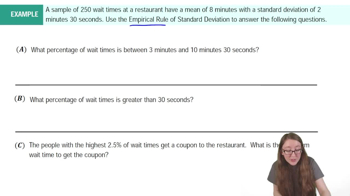
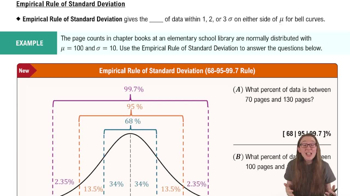
  • Empirical Rule

    A guideline stating that about 68%, 95%, and 99.7% of data fall within one, two, and three standard deviations from the mean in a normal distribution.
  • Z-Score

    A value expressing how many standard deviations a data point is from the mean, aiding in comparison across datasets.
  • Skewness

    A measure of asymmetry in a distribution, affecting how standard deviation describes data spread.
  • Population

    The entire group of individuals or items under study, from which data may be collected.
  • Sample

    A subset of a population, used to estimate characteristics like standard deviation for the whole group.
  • Dispersion

    A general term for the degree to which data values are spread out, with standard deviation as a key measure.
  • Bell Curve

    A graphical representation of a normal distribution, where standard deviation determines the width of the curve.