Back

Interpreting Standard Deviation quiz

Control buttons has been changed to "navigation" mode.
1/15
  • What does standard deviation measure in a data set?

    Standard deviation measures the amount of variation or dispersion from the mean in a data set.
  • If a data set has a low standard deviation, what does that indicate about the data?

    A low standard deviation indicates that the data points are close to the mean and there is little variability.
  • What does a high standard deviation tell us about the spread of data?

    A high standard deviation means the data points are spread out over a wider range of values.
  • How is standard deviation related to the mean of a data set?

    Standard deviation shows how much the data values deviate from the mean on average.
  • Why is standard deviation important in business statistics?

    Standard deviation helps businesses understand risk, variability, and consistency in their data.
  • What does it mean if two data sets have the same mean but different standard deviations?

    It means both sets have the same average, but one has more variability than the other.
  • How can standard deviation help in comparing two different data sets?

    It allows us to compare the consistency and spread of values between the two sets.
  • What is the effect of outliers on standard deviation?

    Outliers increase the standard deviation by making the data more spread out.
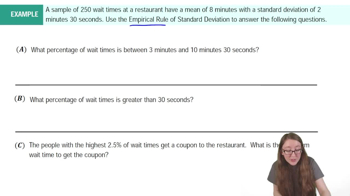
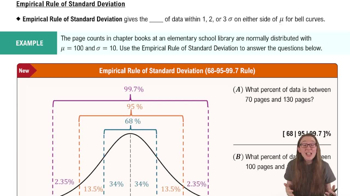
  • In a normal distribution, what percentage of data falls within one standard deviation of the mean?

    About 68% of data falls within one standard deviation of the mean in a normal distribution.
  • What does it mean if the standard deviation is zero?

    It means all data points are exactly equal to the mean, with no variability.
  • How does standard deviation differ from variance?

    Standard deviation is the square root of variance and is in the same units as the data.
  • Why might a business prefer a lower standard deviation in its sales data?

    A lower standard deviation indicates more consistent sales, which is easier to predict and manage.
  • What is the relationship between standard deviation and risk in financial data?

    Higher standard deviation in financial data usually means higher risk due to greater variability.
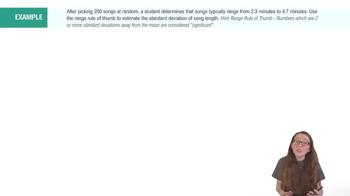
  • How can standard deviation be used to identify unusual data points?

    Data points far from the mean, more than two or three standard deviations away, are considered unusual or outliers.
  • What does standard deviation tell us about the reliability of an average?

    A smaller standard deviation means the average is more reliable, as data points are closer to the mean.