Skip to main content
Statistics for Business
My Course
Learn
Exam Prep
AI Tutor
Study Guides
Flashcards
Explore
Try the app
My Course
Learn
Exam Prep
AI Tutor
Study Guides
Flashcards
Explore
Try the app
Back
Intro to Collecting Data definitions
You can tap to flip the card.
Experiment
You can tap to flip the card.
👆
Experiment
A study where a controlled change is applied to measure its effects, allowing for assumptions about cause and effect.
Track progress
Control buttons has been changed to "navigation" mode.
1/15
Related flashcards
Related practice
Recommended videos
Intro to Collecting Data quiz
Intro to Collecting Data
15 Terms
Intro to Collecting Data
1. Introduction to Statistics
10 problems
Topic
Ernest
Sampling Methods
1. Introduction to Statistics
10 problems
Topic
Ally
1. Introduction to Statistics
3 topics
15 problems
Chapter
Brendan
Guided course
4:01
Introduction to Collecting Data
937
views
26
rank
Terms in this set (15)
Hide definitions
Experiment
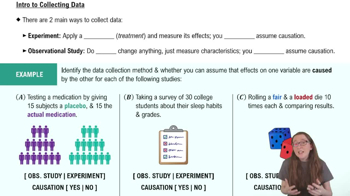
A study where a controlled change is applied to measure its effects, allowing for assumptions about cause and effect.
Observational Study
A study where characteristics are measured without manipulation, preventing assumptions about cause and effect.
Treatment
A specific change or condition applied to subjects in a study to observe its impact on outcomes.
Causation
A relationship where one event is understood to directly produce an effect in another.
Placebo
A fake intervention given to subjects to serve as a control, having no real effect on the outcome.
Survey
A method of collecting data by asking questions to gather information about current characteristics or opinions.
Fair Die
A randomizing device with equal probability for each outcome, used as a standard in probability experiments.
Loaded Die
A randomizing device altered to favor certain outcomes, used to demonstrate effects of manipulation.
Control Group
A set of subjects not receiving the treatment, used as a baseline for comparison in experiments.
Data Collection
The process of gathering information systematically for analysis in a study.
Trend
A pattern or direction observed in data, indicating a possible relationship between variables.
Subject
An individual or entity from which data is collected in a study.
Characteristic
A measurable attribute or feature observed or recorded about subjects in a study.
Manipulation
The deliberate alteration of a variable or condition in an experiment to observe its effect.
Comparison
The act of evaluating differences or similarities between groups or conditions in a study.
 BackBack


 4:01
4:01