Skip to main content
Statistics for Business
My Course
Learn
Exam Prep
AI Tutor
Study Guides
Flashcards
Explore
Try the app
My Course
Learn
Exam Prep
AI Tutor
Study Guides
Flashcards
Explore
Try the app
Back
Link Between Confidence Intervals and Hypothesis Testing definitions
You can tap to flip the card.
Confidence Interval
You can tap to flip the card.
👆
Confidence Interval
A range of values, centered on a sample statistic, used to estimate a population parameter with a specified confidence level.
Track progress
Control buttons has been changed to "navigation" mode.
1/15
Related flashcards
Related practice
Recommended videos
Link Between Confidence Intervals and Hypothesis Testing quiz
Link Between Confidence Intervals and Hypothesis Testing
15 Terms
9. Hypothesis Testing for One Sample
3 topics
15 problems
Chapter
Brendan
Guided course
05:36
Link Between Confidence Intervals and Hypothesis Testing
73
views
1
rank
Terms in this set (15)
Hide definitions
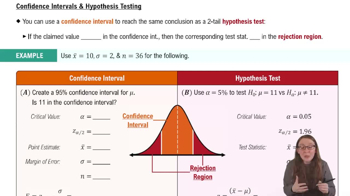
Confidence Interval
A range of values, centered on a sample statistic, used to estimate a population parameter with a specified confidence level.
Hypothesis Test
A statistical method for evaluating a claim about a population parameter using sample data and a formal decision rule.
Population Mean
The average value of a variable for all members of a group being studied, often denoted by the Greek letter mu.
Null Hypothesis
A default assumption that a population parameter equals a specific value, serving as the starting point for statistical testing.
Alternative Hypothesis
A statement that contradicts the null hypothesis, suggesting the population parameter differs from the claimed value.
Critical Value
A cutoff point on the test statistic scale that defines the boundaries of the rejection region for a hypothesis test.
Rejection Region
The set of values for a test statistic that leads to rejection of the null hypothesis in favor of the alternative.
Alpha
The probability of making a Type I error, representing the significance level or the chance of incorrectly rejecting the null hypothesis.
Margin of Error
The maximum expected difference between the sample statistic and the true population parameter for a given confidence level.
Z Score
A standardized value indicating how many standard deviations a data point or statistic is from the population mean.
Two-Tailed Test
A hypothesis test where the rejection regions are located in both tails of the sampling distribution, checking for differences in either direction.
Sample Mean
The average value calculated from a subset of the population, used as a point estimate for the population mean.
Population Standard Deviation
A measure of the spread of all values in a population, denoted by the Greek letter sigma.
Point Estimate
A single value derived from sample data that serves as the best guess for an unknown population parameter.
Population Proportion
The fraction or percentage of members in a population with a particular characteristic, often denoted by p.
 BackBack
 05:36
05:36