Skip to main content
Statistics for Business
My Course
Learn
Exam Prep
AI Tutor
Study Guides
Flashcards
Explore
Try the app
My Course
Learn
Exam Prep
AI Tutor
Study Guides
Flashcards
Explore
Try the app
Back
Mode definitions
You can tap to flip the card.
Mode
You can tap to flip the card.
👆
Mode
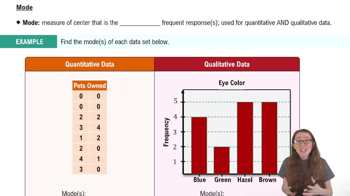
The value in a data set that appears with the highest frequency, indicating the most common observation.
Track progress
Control buttons has been changed to "navigation" mode.
1/12
Related flashcards
Related practice
Recommended videos
Mode quiz
Mode
15 Terms
Mode
3. Describing Data Numerically
10 problems
Topic
Jonathan
Standard Deviation
3. Describing Data Numerically
10 problems
Topic
Jonathan
3. Describing Data Numerically
8 topics
15 problems
Chapter
Jonathan
Guided course
03:20
Mode
344
views
3
rank
Terms in this set (12)
Hide definitions
Mode
The value in a data set that appears with the highest frequency, indicating the most common observation.
Frequency
The number of times a particular value or category occurs within a data set.
Data Set
A collection of related values or observations, often organized for statistical analysis.
Observation
An individual value or measurement recorded within a data set.
Unimodal Distribution
A distribution characterized by a single value occurring most frequently.
Bimodal Distribution
A distribution with two distinct values sharing the highest frequency.
Multimodal Distribution
A distribution containing more than two values that tie for the highest frequency.
Categorical Data
Non-numeric information that can be grouped by categories, often summarized using the most frequent category.
Numerical Data
Quantitative information represented by numbers, suitable for calculating measures like the most common value.
Outlier
A value significantly different from others in a data set, often not affecting the most frequent value.
Central Tendency
A statistical measure that identifies a typical or representative value within a data set.
Nonparametric Measure
A statistic that does not rely on assumptions about the distribution of the underlying data.
 BackBack
 03:20
03:20