Skip to main content
Statistics for Business
My Course
Learn
Exam Prep
AI Tutor
Study Guides
Flashcards
Explore
Try the app
My Course
Learn
Exam Prep
AI Tutor
Study Guides
Flashcards
Explore
Try the app
Back
Multiple Comparisons: Bonferoni Test quiz
You can tap to flip the card.
What is the purpose of a post hoc test after rejecting the null hypothesis in ANOVA?
You can tap to flip the card.
👆
What is the purpose of a post hoc test after rejecting the null hypothesis in ANOVA?
A post hoc test identifies which specific group means differ after the overall ANOVA indicates at least one mean is different.
Track progress
Control buttons has been changed to "navigation" mode.
1/15
Related flashcards
Related practice
Recommended videos
Multiple Comparisons: Bonferoni Test definitions
Multiple Comparisons: Bonferoni Test
15 Terms
14. ANOVA
1 topic
15 problems
Chapter
Ally
Guided course
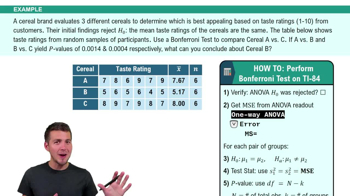
09:54
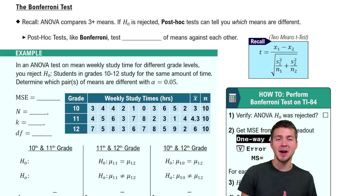
The Bonferroni Test
112
views
Guided course
08:11
The Bonferroni Test Example 1
64
views
Terms in this set (15)
Hide definitions
What is the purpose of a post hoc test after rejecting the null hypothesis in ANOVA?
A post hoc test identifies which specific group means differ after the overall ANOVA indicates at least one mean is different.
Which post hoc test is commonly used to determine which means differ in ANOVA?
The Bonferroni test is a common post hoc test used for pairwise comparisons after ANOVA.
What key value from the ANOVA output is used in the Bonferroni test calculations?
The mean square error (MSE) from the ANOVA output is used in the Bonferroni test calculations.
How do you calculate the t-score for a pairwise comparison in the Bonferroni test?
The t-score is calculated as (mean1 - mean2) divided by the square root of MSE times (1/n1 + 1/n2).
What is the null hypothesis for each pairwise comparison in the Bonferroni test?
The null hypothesis is that the two group means being compared are equal.
How is the p-value adjusted in the Bonferroni test to account for multiple comparisons?
The p-value is multiplied by the number of pairwise comparisons to control for Type I error.
What alternative method can be used instead of multiplying the p-value in the Bonferroni correction?
You can divide the alpha level by the number of pairs instead of multiplying the p-value.
How do you determine the number of pairwise comparisons in a Bonferroni test?
The number of pairs is calculated using the combination formula nCr, where n is the number of groups and r is 2.
What is the significance of comparing the adjusted p-value to the alpha level in the Bonferroni test?
If the adjusted p-value is less than alpha, you reject the null hypothesis for that pair; otherwise, you fail to reject it.
What does it mean if the adjusted p-value is greater than the alpha level in a Bonferroni test?
It means you fail to reject the null hypothesis and conclude there is no significant difference between those means.
What is the main reason for adjusting p-values in multiple comparisons?
Adjusting p-values controls the increased risk of Type I error due to multiple pairwise tests.
What information do you need from the ANOVA output to perform the Bonferroni test?
You need the MSE, sample sizes, number of groups, and degrees of freedom from the ANOVA output.
How do you use a graphing calculator to find the p-value for a t-score in the Bonferroni test?
Use the TCDF function with the t-score and degrees of freedom to find the p-value, then multiply by two for a two-tailed test.
What does rejecting the null hypothesis for a pairwise comparison indicate in the Bonferroni test?
It indicates that the two group means being compared are significantly different from each other.
Why is the Bonferroni test considered tedious in practice?
Because it requires multiple pairwise comparisons and adjustments, making the process lengthy and repetitive.
 BackBack
 09:54
09:54