What is the purpose of the Tukey-Kramer test in statistics?
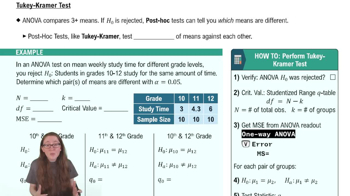
The Tukey-Kramer test is used to compare all possible pairs of means after an ANOVA to determine which means are significantly different.
When should the Tukey-Kramer test be applied?
It should be applied after finding a significant result in ANOVA when comparing three or more group means.
What does the Tukey-Kramer test control for in multiple comparisons?
It controls the family-wise error rate, reducing the likelihood of Type I errors when making multiple comparisons.
How does the Tukey-Kramer test differ from the original Tukey test?
The Tukey-Kramer test is an extension of the Tukey test that accommodates unequal sample sizes among groups.
What is the formula for the Tukey-Kramer test statistic?
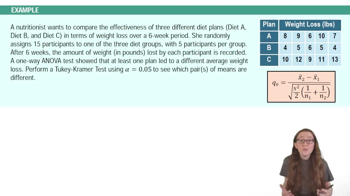
The test statistic is the difference between two group means divided by the square root of the mean square error times the sum of the reciprocals of the group sample sizes.
What distribution does the Tukey-Kramer test statistic follow?
It follows the studentized range distribution, which is used to determine critical values for significance.
What is the null hypothesis in the Tukey-Kramer test?
The null hypothesis states that the means of the groups being compared are equal.
What is the family-wise error rate?
The family-wise error rate is the probability of making at least one Type I error across all pairwise comparisons.
Why is it important to use a post-hoc test like Tukey-Kramer after ANOVA?
Because ANOVA only tells us if at least one mean is different, post-hoc tests identify which specific means differ.
What is the mean square error (MSE) in the Tukey-Kramer test?
MSE is the pooled estimate of variance within groups, used in the denominator of the Tukey-Kramer test statistic.
How are critical values determined in the Tukey-Kramer test?
Critical values are obtained from the studentized range distribution table based on the number of groups and degrees of freedom.
What does a significant Tukey-Kramer test result indicate?
It indicates that the means of the compared groups are significantly different from each other.
Can the Tukey-Kramer test be used with unequal sample sizes?
Yes, the Tukey-Kramer test is specifically designed to handle unequal sample sizes among groups.
What is a pairwise comparison in the context of the Tukey-Kramer test?
A pairwise comparison is the comparison of means between two groups at a time.
What is the main advantage of the Tukey-Kramer test over other post-hoc tests?
Its main advantage is controlling the family-wise error rate while allowing for unequal sample sizes.
 Back
Back
 06:42
06:42