Skip to main content
Statistics for Business
My Course
Learn
Exam Prep
AI Tutor
Study Guides
Flashcards
Explore
Try the app
My Course
Learn
Exam Prep
AI Tutor
Study Guides
Flashcards
Explore
Try the app
Back
Multiple Comparisons: Tukey Test definitions
You can tap to flip the card.
Post Hoc Test
You can tap to flip the card.
👆
Post Hoc Test
A follow-up procedure used after an ANOVA to determine which group means show significant differences.
Track progress
Control buttons has been changed to "navigation" mode.
1/15
Related flashcards
Related practice
Recommended videos
Multiple Comparisons: Tukey Test quiz
Multiple Comparisons: Tukey Test
15 Terms
14. ANOVA
1 topic
15 problems
Chapter
Ally
Guided course
08:22
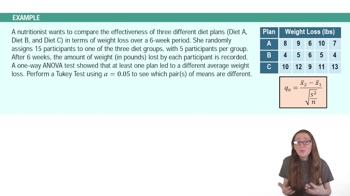
Tukey Test
167
views
Guided course
05:55
Tukey Test Example 1
120
views
1
rank
Terms in this set (15)
Hide definitions
Post Hoc Test
A follow-up procedure used after an ANOVA to determine which group means show significant differences.
Tukey Test
A method for comparing all possible pairs of group means to identify specific differences after ANOVA.
ANOVA
A statistical technique for testing whether three or more group means are equal using variance analysis.
Null Hypothesis
A statement that assumes no difference exists between group means in a statistical test.
Alternative Hypothesis
A claim that at least one group mean differs from the others in a statistical comparison.
Q Statistic
A calculated value representing the standardized difference between two group means in the Tukey test.
Critical Value
A threshold from statistical tables used to decide whether a test statistic indicates a significant result.
Studentized Range Distribution
A probability distribution used to determine critical values for comparing multiple group means.
Degrees of Freedom
A value found by subtracting the number of groups from the total observations, used in statistical tests.
Mean Square Error
A measure of variance within groups, calculated from ANOVA output and used in the Tukey test formula.
Pairwise Comparison
An analysis that examines differences between every possible pair of group means.
Alpha Level
The probability threshold, often set at 0.05, for determining statistical significance in hypothesis testing.
Sample Size
The number of observations in each group, used in calculations for statistical tests.
Variance Within Groups
The average of squared differences from the group mean, reflecting variability inside each group.
Q Table
A reference chart providing critical values for the studentized range distribution based on test parameters.
 BackBack
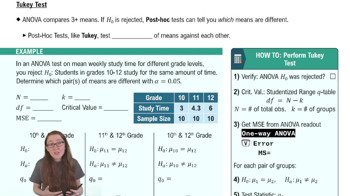
 08:22
08:22