Skip to main content
Statistics for Business
My Course
Learn
Exam Prep
AI Tutor
Study Guides
Flashcards
Explore
Try the app
My Course
Learn
Exam Prep
AI Tutor
Study Guides
Flashcards
Explore
Try the app
Back
Multiplication Rule: Dependent Events definitions
You can tap to flip the card.
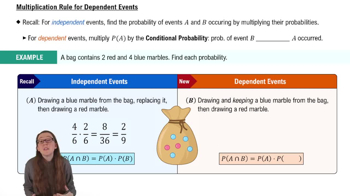
Dependent Events
You can tap to flip the card.
👆
Dependent Events
Situations where the outcome of one occurrence influences the likelihood of another in a probability scenario.
Track progress
Control buttons has been changed to "navigation" mode.
1/15
Related flashcards
Related practice
Recommended videos
Multiplication Rule: Dependent Events quiz
Multiplication Rule: Dependent Events
15 Terms
Multiplication Rule: Dependent Events
4. Probability
10 problems
Topic
Brendan
Bayes' Theorem
4. Probability
7 problems
Topic
Ally
4. Probability
9 topics
15 problems
Chapter
Ernest
Guided course
02:46
Multiplication Rule: Dependent Events Example 1
274
views
7
rank
05:17
Multiplication Rule: Dependent Events
410
views
14
rank
Guided course
03:25
Conditional Probability Rule Example 3
218
views
9
rank
Terms in this set (15)
Hide definitions
Dependent Events
Situations where the outcome of one occurrence influences the likelihood of another in a probability scenario.
Independent Events
Occurrences where the result of one does not alter the probability of the other happening.
Conditional Probability
The chance of an outcome occurring, assuming that another specific outcome has already taken place.
Multiplication Rule
A method for finding the probability of two events both happening by multiplying relevant probabilities.
Probability Formula
An equation used to calculate the likelihood of events, often involving multiplication or division of probabilities.
Sample Space
The complete set of all possible outcomes in a probability experiment or scenario.
Numerator
The top part of a fraction representing the number of favorable outcomes in probability calculations.
Denominator
The bottom part of a fraction indicating the total number of possible outcomes in probability.
Double Major
A situation where an individual fulfills the requirements for two academic disciplines simultaneously.
Survey
A method of collecting data from a group to analyze probabilities or frequencies of certain characteristics.
Event A
The initial occurrence or condition in a probability problem, often the 'given' situation.
Event B
The subsequent occurrence or condition whose probability is evaluated, often dependent on Event A.
Vertical Line Notation
A symbol used to denote 'given that' in conditional probability, as in P(B | A).
Real-World Scenario
A practical context where probability concepts are applied to analyze outcomes or make decisions.
Fraction Simplification
The process of reducing a probability fraction to its lowest terms for clearer interpretation.
 BackBack


 02:46
02:46