Skip to main content
Statistics for Business
My Course
Learn
Exam Prep
AI Tutor
Study Guides
Flashcards
Explore
Try the app
My Course
Learn
Exam Prep
AI Tutor
Study Guides
Flashcards
Explore
Try the app
Back
Multiplication Rule: Independent Events quiz
You can tap to flip the card.
What does it mean for two events to be independent?
You can tap to flip the card.
👆
What does it mean for two events to be independent?
Two events are independent if the outcome of one does not affect the outcome of the other.
Track progress
Control buttons has been changed to "navigation" mode.
1/15
Related flashcards
Related practice
Recommended videos
Multiplication Rule: Independent Events definitions
Multiplication Rule: Independent Events
15 Terms
Multiplication Rule: Independent Events
4. Probability
10 problems
Topic
Ernest
Introduction to Contingency Tables
4. Probability
7 problems
Topic
Ernest
4. Probability
9 topics
15 problems
Chapter
Ernest
05:54
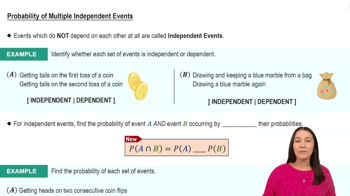
Probability of Multiple Independent Events
531
views
14
rank
Terms in this set (15)
Hide definitions
What does it mean for two events to be independent?
Two events are independent if the outcome of one does not affect the outcome of the other.
How do you calculate the probability of two independent events both occurring?
Multiply the probability of the first event by the probability of the second event.
What is the probability of getting heads on two consecutive coin flips?
The probability is (1/2) × (1/2) = 1/4 or 0.25.
What is 'and probability' in the context of independent events?
'And probability' refers to the probability that both events occur, calculated by multiplying their individual probabilities.
How can you tell if two events are dependent?
Two events are dependent if the outcome of one affects the probability of the other.
What is the probability of rolling an even number and then a three on a six-sided die?
The probability is (3/6) × (1/6) = 3/36 or 0.08.
If you draw and keep a blue marble, then draw again, are these events independent?
No, because removing a marble changes the probability for the second draw, making the events dependent.
What symbol is often used in set notation to represent 'and' probability?
The upside down 'U' symbol (∩) is used to represent 'and' probability.
How do you find the probability of three independent events all occurring?
Multiply the probabilities of all three events together.
Why is the probability of getting heads on two coin flips 1/4?
Because there are four possible outcomes and only one is heads on both flips.
What is the probability of rolling a three on a six-sided die?
The probability is 1/6.
If the outcome of one event does not change the probability of another, what are the events called?
They are called independent events.
What do you do if you need to find the 'and probability' for more than two independent events?
Continue multiplying the probability of each event together.
Give an example of two independent events.
Flipping a coin and rolling a die are independent because one does not affect the other.
What is the probability of getting tails on the first coin flip and heads on the second?
The probability is (1/2) × (1/2) = 1/4.
 BackBack
 05:54
05:54