Skip to main content
Statistics for Business
My Course
Learn
Exam Prep
AI Tutor
Study Guides
Flashcards
Explore
Try the app
My Course
Learn
Exam Prep
AI Tutor
Study Guides
Flashcards
Explore
Try the app
Back
Performing Hypothesis Tests: Means definitions
You can tap to flip the card.
Null Hypothesis
You can tap to flip the card.
👆
Null Hypothesis
Default assumption about a population parameter, typically stating no effect or no difference.
Track progress
Control buttons has been changed to "navigation" mode.
1/15
Related flashcards
Related practice
Recommended videos
Performing Hypothesis Tests: Means quiz
Performing Hypothesis Tests: Means
15 Terms
Performing Hypothesis Tests: Means
9. Hypothesis Testing for One Sample
10 problems
Topic
Laura
9. Hypothesis Testing for One Sample
3 topics
15 problems
Chapter
Brendan
Guided course
04:53
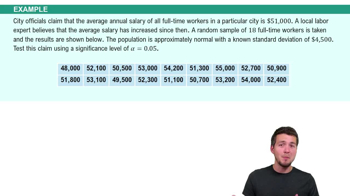
Standard Deviation (σ) Known Example 2
151
views
1
rank
Guided course
06:51
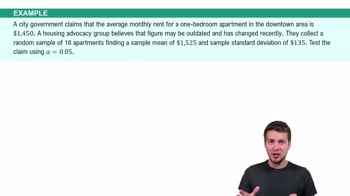
Standard Deviation (σ) Known Example 3
129
views
2
rank
Guided course
06:13
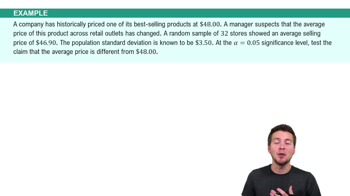
Standard Deviation (σ) Unknown Example 4
147
views
Terms in this set (15)
Hide definitions
Null Hypothesis
Default assumption about a population parameter, typically stating no effect or no difference.
Alternative Hypothesis
Statement suggesting a different claim about a population parameter, often what the test seeks evidence for.
Population Mean
Average value of a characteristic for all members of a group under study, denoted by the Greek letter mu.
Population Standard Deviation
Measure of spread for all values in a population, represented by the Greek letter sigma.
Sample Mean
Average value calculated from a subset of the population, often denoted as x-bar.
Sample Standard Deviation
Measure of spread for values in a sample, represented by the letter s.
Significance Level
Threshold probability, denoted by alpha, used to decide whether to reject the null hypothesis.
Test Statistic
Calculated value summarizing sample data, used to determine how far the sample result is from the hypothesized value.
Z-Test
Statistical test used when the population standard deviation is known and the sample size is sufficiently large.
T-Test
Statistical test used when the population standard deviation is unknown, relying on the t-distribution.
P-Value
Probability of observing a test statistic as extreme as, or more extreme than, the one calculated, assuming the null hypothesis is true.
Degrees of Freedom
Value calculated as sample size minus one, used in t-distribution calculations.
Random Sample
Subset of a population selected so that every member has an equal chance of being chosen.
Normal Distribution
Symmetrical, bell-shaped curve describing the spread of a characteristic in a population.
Critical Value
Cutoff point on the test statistic distribution used to decide whether to reject the null hypothesis.
 BackBack

 04:53
04:53