Skip to main content
Statistics for Business
My Course
Learn
Exam Prep
AI Tutor
Study Guides
Flashcards
Explore
Try the app
My Course
Learn
Exam Prep
AI Tutor
Study Guides
Flashcards
Explore
Try the app
Back
Performing Hypothesis Tests: Means quiz
You can tap to flip the card.
What is the null hypothesis (H0) in a hypothesis test for means?
You can tap to flip the card.
👆
What is the null hypothesis (H0) in a hypothesis test for means?
The null hypothesis states that the population mean equals a specific value, such as H0: μ = 25,000.
Track progress
Control buttons has been changed to "navigation" mode.
1/15
Related flashcards
Related practice
Recommended videos
Performing Hypothesis Tests: Means definitions
Performing Hypothesis Tests: Means
15 Terms
Performing Hypothesis Tests: Means
9. Hypothesis Testing for One Sample
10 problems
Topic
Laura
9. Hypothesis Testing for One Sample
3 topics
15 problems
Chapter
Brendan
Guided course
04:53
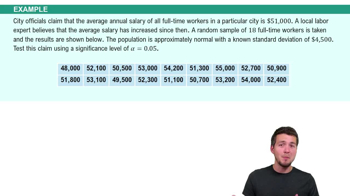
Standard Deviation (σ) Known Example 2
151
views
1
rank
Guided course
06:51
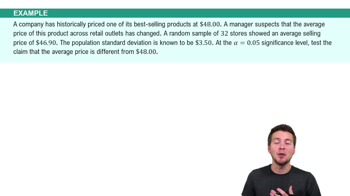
Standard Deviation (σ) Known Example 3
129
views
2
rank
Guided course
06:13
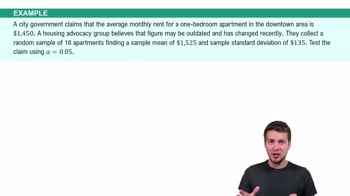
Standard Deviation (σ) Unknown Example 4
147
views
Terms in this set (15)
Hide definitions
What is the null hypothesis (H0) in a hypothesis test for means?
The null hypothesis states that the population mean equals a specific value, such as H0: μ = 25,000.
When should you use a z-test instead of a t-test in hypothesis testing for means?
A z-test is used when the population standard deviation (σ) is known; a t-test is used when σ is unknown.
What does the alternative hypothesis (Ha) represent in a hypothesis test?
The alternative hypothesis suggests a different claim about the population mean, such as Ha: μ < 25,000.
How do you calculate the test statistic for a z-test?
The z-test statistic is calculated as (sample mean - population mean) divided by (σ / sqrt(n)).
What is the formula for the t-test statistic when σ is unknown?
The t-test statistic is (sample mean - population mean) divided by (s / sqrt(n)), where s is the sample standard deviation.
What is the significance level (alpha) in hypothesis testing?
Alpha (α) is the threshold probability for rejecting the null hypothesis, commonly set at 0.05 or 0.1.
What does the p-value represent in hypothesis testing?
The p-value is the probability of observing the sample data, or more extreme, assuming the null hypothesis is true.
What is the decision rule for rejecting the null hypothesis based on the p-value?
If the p-value is less than alpha, we reject the null hypothesis; otherwise, we fail to reject it.
What are the criteria for using a z-test or t-test for means?
You need a random sample and either a normal distribution or a sample size greater than 30.
How do you determine the direction of the test (left, right, or two-tailed)?
The direction depends on the alternative hypothesis: '<' for left-tailed, '>' for right-tailed, and '≠' for two-tailed.
What is the role of degrees of freedom in a t-test?
Degrees of freedom for a t-test is n - 1, where n is the sample size, and it is used to find the p-value.
How do you use a TI-84 calculator to perform a z-test for means?
Select the Z-Test function, input the population mean, σ, sample mean, sample size, and choose the correct alternative hypothesis.
What information do you need to perform a t-test on a TI-84 calculator?
You need the sample mean, sample standard deviation, sample size, and the hypothesized population mean.
What does it mean if the p-value is greater than alpha in a hypothesis test?
If p-value > alpha, we fail to reject the null hypothesis, indicating insufficient evidence for the alternative hypothesis.
Why is it important to check if the sample is random and the distribution is normal or n > 30?
These conditions ensure the validity of the hypothesis test and allow the use of z or t distributions.
 BackBack

 04:53
04:53