Skip to main content
Statistics for Business
My Course
Learn
Exam Prep
AI Tutor
Study Guides
Flashcards
Explore
Try the app
My Course
Learn
Exam Prep
AI Tutor
Study Guides
Flashcards
Explore
Try the app
Back
Performing Hypothesis Tests: Variance quiz
You can tap to flip the card.
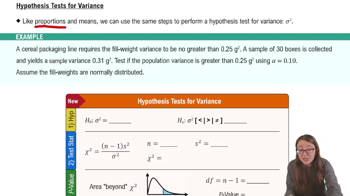
What is the formula for the chi-square test statistic when testing a population variance?
You can tap to flip the card.
👆
What is the formula for the chi-square test statistic when testing a population variance?
The formula is χ² = (n−1)s²/σ², where n is sample size, s² is sample variance, and σ² is the hypothesized population variance.
Track progress
Control buttons has been changed to "navigation" mode.
1/15
Related flashcards
Related practice
Recommended videos
Performing Hypothesis Tests: Variance definitions
Performing Hypothesis Tests: Variance
15 Terms
9. Hypothesis Testing for One Sample
3 topics
15 problems
Chapter
Brendan
Guided course
04:09
Performing Hypothesis Tests: Variance Example 1
72
views
Guided course
04:05
Performing Hypothesis Tests: Variance
82
views
Terms in this set (15)
Hide definitions
What is the formula for the chi-square test statistic when testing a population variance?
The formula is χ² = (n−1)s²/σ², where n is sample size, s² is sample variance, and σ² is the hypothesized population variance.
What are the two main conditions that must be met to perform a hypothesis test for population variance?
The sample must be random and the data must be normally distributed.
In the cereal packaging example, what is the null hypothesis for the variance?
The null hypothesis is that the population variance σ² equals 0.25 grams squared.
How do you calculate degrees of freedom for the chi-square test for variance?
Degrees of freedom are calculated as n - 1, where n is the sample size.
If you are given the sample standard deviation, how do you find the sample variance?
You square the sample standard deviation to get the sample variance.
What does a right-tailed alternative hypothesis indicate in a variance test?
It indicates you are testing if the population variance is greater than the hypothesized value.
What is the next step after calculating the chi-square test statistic in a variance test?
You use the test statistic to find the p-value, using the degrees of freedom.
How do you decide whether to reject the null hypothesis in a variance test?
Compare the p-value to the alpha level; if the p-value is less than alpha, reject the null hypothesis.
In the example, what was the calculated chi-square test statistic value?
The calculated chi-square value was approximately 44.59.
What was the sample size in the cereal packaging variance test example?
The sample size was 30.
What was the sample variance in the cereal packaging example?
The sample variance was 0.31 grams squared.
What was the significance level (alpha) used in the example?
The significance level was 0.1.
What was the approximate p-value found in why the example?
The p-value was approximately 0.032.
What conclusion was drawn from the hypothesis test in the example?
The null hypothesis was rejected, suggesting the population variance is greater than 0.25 grams squared.
Why is it important to check the conditions before drawing a conclusion in a variance hypothesis test?
Checking conditions ensures the validity of the test results; the sample must be random and data normally distributed.
 BackBack
 04:09
04:09