Skip to main content
Statistics for Business
My Course
Learn
Exam Prep
AI Tutor
Study Guides
Flashcards
Explore
Try the app
My Course
Learn
Exam Prep
AI Tutor
Study Guides
Flashcards
Explore
Try the app
Back
Pie Charts definitions
You can tap to flip the card.
Pie Chart
You can tap to flip the card.
👆
Pie Chart
A circular graph divided into wedges, each representing a category's percentage of the total.
Track progress
Control buttons has been changed to "navigation" mode.
1/15
Related flashcards
Related practice
Recommended videos
Pie Charts quiz
Pie Charts
15 Terms
Pie Charts
2. Describing Data with Tables and Graphs
10 problems
Topic
Ally
Frequency Polygons
2. Describing Data with Tables and Graphs
10 problems
Topic
2. Describing Data with Tables and Graphs
10 topics
15 problems
Chapter
David-Paige
Guided course
01:18
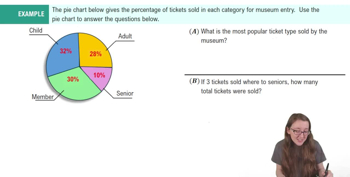
Example 1
197
views
8
rank
Guided course
06:10
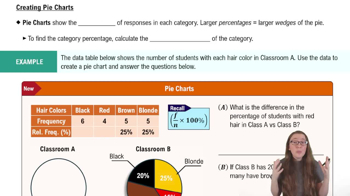
Creating Pie Charts
288
views
7
rank
Terms in this set (15)
Hide definitions
Pie Chart
A circular graph divided into wedges, each representing a category's percentage of the total.
Wedge
A section of a circular graph whose size visually represents a category's proportion of the whole.
Category
A distinct group or label used to classify qualitative data within a dataset.
Percentage
A value expressing a part of the total as parts per hundred, used to compare categories.
Frequency
The count of responses or occurrences for a specific group within the data.
Relative Frequency
A ratio showing how often a group appears compared to the total, often converted to a percent.
Total Number of Responses
The sum of all category counts, serving as the denominator for percentage calculations.
Label
A descriptive tag placed on a graph section to identify the group it represents.
Comparison
The process of evaluating differences or similarities between groups using visual or numerical data.
Qualitative Data
Non-numeric information categorized by attributes or characteristics, often shown in graphs.
Table
An organized arrangement of data in rows and columns, often used before creating graphs.
Decimal
A numerical representation used to convert percentages for calculations, such as 0.40 for 40%.
Shading
A visual technique used to distinguish different sections of a graph for clarity.
Percentage Point
A unit for expressing the absolute difference between two percentages.
Group
A collection of data points sharing a common attribute within a dataset.
 BackBack

 01:18
01:18