Back

Sampling Distribution of Sample Proportion definitions

Control buttons has been changed to "navigation" mode.
1/15
  • Binomial Distribution

    A probability model for experiments with two outcomes per trial, such as success or failure, over a fixed number of trials.
  • Normal Distribution

    A symmetric, bell-shaped curve used to approximate probabilities when sample sizes are large and certain criteria are met.
  • Sample Proportion

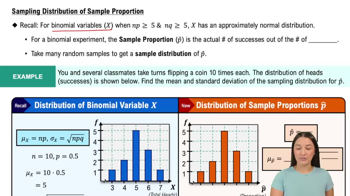
    A value calculated by dividing the number of successes in a sample by the total number of trials, often denoted as p-hat.
  • p-hat

    A statistic representing the proportion of successes in a sample, found by dividing successes by total trials.
  • Continuity Correction

    An adjustment of 0.5 added or subtracted to a discrete variable when using a continuous distribution to approximate probabilities.
  • Z Score

    A standardized value indicating how many standard deviations a data point is from the mean in a normal distribution.
  • Standard Deviation

    A measure of the spread of a distribution, for sample proportions calculated as the square root of pq divided by n.
  • Mean

    The expected value of a distribution; for sample proportions, it equals the population probability of success.
  • n

    The total number of trials or observations in a sample or experiment.
  • p

    The probability of success on a single trial in a binomial experiment.
  • q

    The probability of failure on a single trial, calculated as one minus the probability of success.
  • Confidence Interval

    A range of values, derived from sample data, likely to contain the true population proportion with a specified probability.
  • Sampling Distribution

    The probability distribution of a statistic, such as p-hat, based on all possible random samples from a population.
  • np

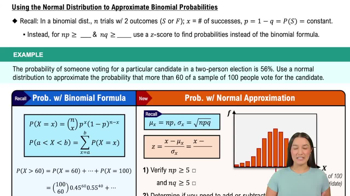
    The product of sample size and probability of success, used to check if normal approximation is appropriate.
  • nq

    The product of sample size and probability of failure, also used to verify conditions for normal approximation.