Back

Sampling Distribution of Sample Proportion quiz

Control buttons has been changed to "navigation" mode.
1/15
  • What are the two conditions that must be met to approximate a binomial distribution with a normal distribution?

    Both np and nq (where q = 1 - p) must be greater than or equal to 5.
  • How do you calculate the sample proportion, denoted as p-hat?

    The sample proportion p-hat is calculated as x divided by n, where x is the number of successes and n is the total number of trials.
  • What is the mean of the sampling distribution of the sample proportion p-hat?

    The mean of the sampling distribution of p-hat is equal to the population proportion p.
  • How do you calculate the standard deviation of the sampling distribution of p-hat?

    The standard deviation is calculated as the square root of p times q divided by n, or sqrt(pq/n).
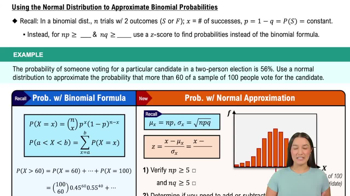
  • Why do we use a continuity correction when approximating binomial probabilities with the normal distribution?

    We use a continuity correction because the binomial distribution is discrete and the normal distribution is continuous, so we adjust by 0.5 to better approximate probabilities.
  • If you want to find the probability that x is greater than a certain value using the normal approximation, what continuity correction should you apply?

    You should add 0.5 to the value of x before calculating the z-score.
  • What is the formula for the z-score when using the normal approximation for a binomial distribution?

    The z-score is (x - np) divided by the square root of npq.
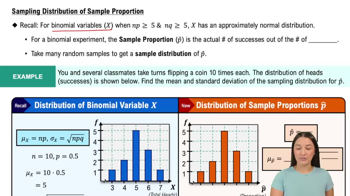
  • How is the sampling distribution of p-hat related to the binomial distribution?

    The sampling distribution of p-hat is essentially the binomial distribution rescaled by dividing the x-axis by n.
  • What does the variable q represent in binomial and sampling distribution formulas?

    q represents the probability of failure, which is 1 minus p.
  • When calculating the mean and standard deviation for p-hat, what values do you use for n and p?

    You use the same values for n (number of trials) and p (probability of success) as in the original binomial experiment.
  • Why is the normal approximation useful for large sample sizes in binomial experiments?

    Because calculating binomial probabilities directly becomes tedious for large n, and the normal approximation simplifies the process.
  • What is the main criterion for the sampling distribution of p-hat to be approximately normal?

    Both np and nq must be greater than or equal to 5.
  • How do you find the probability that more than a certain number of people have a characteristic in a sample using the normal approximation?

    Apply the continuity correction by adding 0.5 to the number, calculate the z-score, and use the standard normal table or calculator to find the probability.
  • If the probability of success in a binomial experiment is 0.5 and n is 10, what is the mean of the sampling distribution of p-hat?

    The mean is 0.5, which is the same as the probability of success p.
  • What is the formula for the standard deviation of p-hat if p = 0.5 and n = 10?

    The standard deviation is sqrt(0.5 * 0.5 / 10), which equals 0.158.