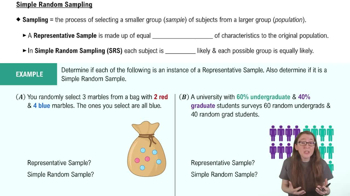
A representative sample mirrors the population's characteristics in similar proportions, making it a smaller version of the population.
Why do we use samples instead of collecting data from the entire population?
Collecting data from the entire population is often impractical, so we use samples to make inferences about the whole group.
What is simple random sampling (SRS)?
Simple random sampling is a method where each subject and each possible sample has an equal chance of being selected from the population.
How does systematic sampling select subjects?
Systematic sampling selects every kth subject from the population, where k is a fixed interval.
What is cluster sampling?
Cluster sampling divides the population into groups (clusters), randomly selects one or more clusters, and includes all members of those clusters in the sample.
How does stratified sampling ensure representation?
Stratified sampling divides the population into subgroups (strata) based on shared characteristics and randomly selects members from each subgroup.
Give an example of when a simple random sample might not be representative.
If the sample size is very small, like selecting three marbles from a bag, the sample may not reflect the population's proportions.
What is the main advantage of using systematic sampling in assembly line situations?
Systematic sampling provides a clear, repeatable procedure for selecting samples as items are produced, making it practical for ongoing processes.
How does cluster sampling differ from stratified sampling?
Cluster sampling selects entire groups at random, while stratified sampling selects individuals from each subgroup to ensure all characteristics are represented.
Why might a researcher choose stratified sampling?
A researcher might choose stratified sampling to guarantee that all important subgroups of the population are represented in the sample.
What is a potential drawback of simple random sampling?
A potential drawback is that, by chance, the sample may not be representative, especially with small sample sizes.
In the context of sampling, what does 'k' represent in systematic sampling?
'k' represents the fixed interval at which subjects are selected from the population (e.g., every 12th cookie).
What is an example of cluster sampling in a school setting?
Randomly selecting one class per grade and surveying every student in the selected class is an example of cluster sampling.
How can a sample be representative but not a simple random sample?
If the sample's proportions match the population but is selected by another method (like stratified sampling), it can be representative without being a simple random sample.
What is the main goal of using different sampling methods?
The main goal is to obtain a sample that accurately reflects the population, reducing sampling error and improving the reliability of conclusions.
 Back
Back


 04:17
04:17