Skip to main content
Statistics for Business
My Course
Learn
Exam Prep
AI Tutor
Study Guides
Flashcards
Explore
Try the app
My Course
Learn
Exam Prep
AI Tutor
Study Guides
Flashcards
Explore
Try the app
Back
Standard Deviation quiz
You can tap to flip the card.
What does the standard deviation measure in a data set?
You can tap to flip the card.
👆
What does the standard deviation measure in a data set?
Standard deviation measures how spread out the data values are around the mean.
Track progress
Control buttons has been changed to "navigation" mode.
1/15
Related flashcards
Related practice
Recommended videos
Standard Deviation definitions
Standard Deviation
15 Terms
Standard Deviation
3. Describing Data Numerically
10 problems
Topic
Jonathan
Interpreting Standard Deviation
3. Describing Data Numerically
8 problems
Topic
Ernest
3. Describing Data Numerically
8 topics
15 problems
Chapter
Jonathan
Guided course
08:45
Calculating Standard Deviation
605
views
10
rank
Guided course
02:59
Calculating Standard Deviation Example 1
355
views
7
rank
Terms in this set (15)
Hide definitions
What does the standard deviation measure in a data set?
Standard deviation measures how spread out the data values are around the mean.
What symbol is commonly used to represent standard deviation?
The letter 's' is commonly used to represent standard deviation.
If two data sets have the same mean but different standard deviations, what does this indicate?
It indicates that the data sets have different levels of dispersion or spread around the mean.
What is the formula for calculating the sample standard deviation?
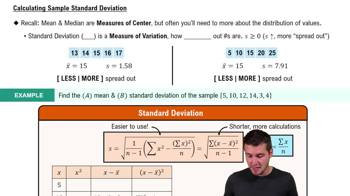
The formula is s = sqrt{1/(n-1) [Σx² - (Σx)²/n]}.
What does a higher value of standard deviation signify about a data set?
A higher standard deviation means the data values are more spread out from the mean.
What is the first step in calculating the mean of a sample?
Add up all the data values and divide by the total number of observations.
How do you calculate Σx² in the standard deviation formula?
Square each data value and then add them all together.
What is the difference between Σx² and (Σx)² in the standard deviation calculation?
Σx² is the sum of squared data values, while (Σx)² is the square of the sum of data values.
Why do we divide by n-1 instead of n when calculating sample standard deviation?
Dividing by n-1 corrects for bias in estimating the population standard deviation from a sample.
What does the square root in the standard deviation formula accomplish?
It converts the variance into the same units as the original data, giving the standard deviation.
What is the standard deviation of the sample {5, 10, 12, 14, 3, 4} as calculated in the lesson?
The standard deviation is 4.6.
What is the alternative formula for standard deviation involving deviations from the mean?
It is s = sqrt{Σ(x - x̄)² / (n-1)}, where x̄ is the mean.
What is the purpose of squaring the differences from the mean in the standard deviation calculation?
Squaring ensures all differences are positive and emphasizes larger deviations.
What symbols are used for population standard deviation and mean?
Population standard deviation is denoted by σ (sigma) and mean by μ (mu).
When should you use the 's' formula for standard deviation?
Use the 's' formula when calculating standard deviation for a sample unless otherwise stated.
 BackBack

 08:45
08:45