Back

Standard Normal Distribution quiz

Control buttons has been changed to "navigation" mode.
1/15
  • What does a z-score represent in the standard normal distribution?

    A z-score measures how many standard deviations a value is from the mean in the standard normal distribution.
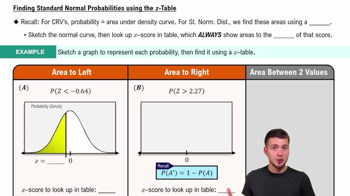
  • How do you find the probability that z is less than a given value using a z-table?

    Look up the given z-score in the z-table; the value you find is the probability that z is less than that value.
  • What does the area under the standard normal curve represent?

    The area under the curve represents probability, with the total area equal to 1.
  • What is the first step you should take when solving a standard normal probability problem?

    You should draw a sketch of the normal curve and shade the area corresponding to the probability you are finding.
  • How are the values in a z-table organized?

    The rows represent the tenths place of the z-score, and the columns represent the hundredths place.
  • If you are asked to find the probability that z is greater than a given value, what should you do with the z-table value?

    Subtract the z-table value from 1 to get the probability to the right of the given z-score.
  • What does the z-table value always represent by default?

    It always represents the cumulative probability (area) to the left of the given z-score.
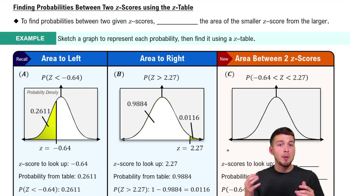
  • How do you find the probability that z is between two values using the z-table?

    Subtract the smaller cumulative area (from the lower z-score) from the larger cumulative area (from the higher z-score).
  • What is the probability that z is less than -0.64, given the z-table value is 0.2611?

    The probability is 0.2611, as read directly from the z-table.
  • If the z-table value for z = 2.27 is 0.9884, what is the probability that z is greater than 2.27?

    The probability is 1 - 0.9884 = 0.0116.
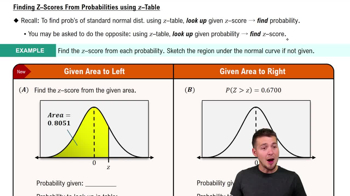
  • How do you find a z-score given a cumulative probability (area to the left)?

    Look up the given probability in the z-table and find the corresponding z-score.
  • If you are given an area to the right of a z-score, what must you do before using the z-table?

    Subtract the given area from 1 to find the area to the left, then use the z-table.
  • What is the z-score corresponding to a cumulative probability of 0.8051?

    The z-score is 0.86.
  • If the area to the right of a z-score is 0.67, what is the z-score?

    First, find the area to the left (1 - 0.67 = 0.33), then look up 0.33 in the z-table to get z = -0.44.
  • Why is it important to draw a graph when solving standard normal distribution problems?

    Drawing a graph helps you visualize the area you are finding and reduces the chance of making mistakes.