Skip to main content
Statistics for Business
My Course
Learn
Exam Prep
AI Tutor
Study Guides
Flashcards
Explore
Try the app
My Course
Learn
Exam Prep
AI Tutor
Study Guides
Flashcards
Explore
Try the app
Back
Steps in Hypothesis Testing definitions
You can tap to flip the card.
Null Hypothesis
You can tap to flip the card.
👆
Null Hypothesis
A default claim about a population parameter, typically involving equality, assumed true until evidence suggests otherwise.
Track progress
Control buttons has been changed to "navigation" mode.
1/15
Related flashcards
Related practice
Recommended videos
Steps in Hypothesis Testing quiz #1
Steps in Hypothesis Testing
10 Terms
Steps in Hypothesis Testing
9. Hypothesis Testing for One Sample
10 problems
Topic
Ernest
Performing Hypothesis Tests: Means
9. Hypothesis Testing for One Sample
10 problems
Topic
Laura
9. Hypothesis Testing for One Sample
3 topics
15 problems
Chapter
Brendan
Guided course
05:12
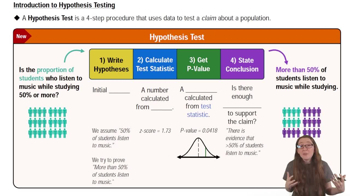
Intro to Hypothesis Testing
369
views
3
rank
Guided course
06:50
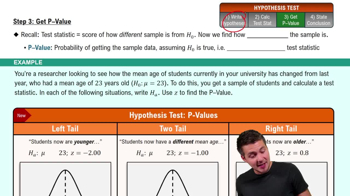
Step 3: Get P-Value
365
views
5
rank
Guided course
06:34
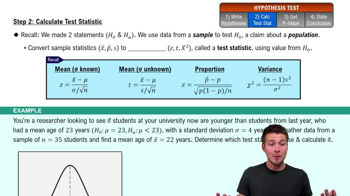
Step 2: Calculate Test Statistic
359
views
9
rank
Terms in this set (15)
Hide definitions
Null Hypothesis
A default claim about a population parameter, typically involving equality, assumed true until evidence suggests otherwise.
Alternative Hypothesis
A competing claim to the null, representing what the researcher seeks evidence for, often involving inequality.
Test Statistic
A calculated value, such as a z or t score, that measures how far sample data deviates from the assumed population parameter.
Z Score
A standardized value indicating how many standard deviations a sample statistic is from the population mean.
T Score
A standardized value used when population standard deviation is unknown, reflecting sample mean deviation from the population mean.
P Value
A probability quantifying how likely observed sample results are, assuming the null hypothesis is true.
Significance Level
A threshold, often denoted alpha, that determines how unlikely a result must be to reject the null hypothesis.
Critical Region
The set of values for the test statistic where the null hypothesis is rejected, defined by the significance level.
Left Tailed Test
A test where the alternative hypothesis suggests a parameter is less than a specific value, focusing on the lower tail.
Right Tailed Test
A test where the alternative hypothesis suggests a parameter is greater than a specific value, focusing on the upper tail.
Two Tailed Test
A test where the alternative hypothesis suggests a parameter differs from a specific value, considering both tails.
Population Parameter
A numerical value summarizing a characteristic of an entire population, such as mean, proportion, or standard deviation.
Sample Statistic
A numerical value calculated from sample data, used to estimate or test claims about a population parameter.
Rejection Rule
A guideline comparing the p value to the significance level to decide whether to reject or fail to reject the null hypothesis.
Evidence
The degree to which sample data supports or contradicts a claim about a population, influencing hypothesis test conclusions.
 BackBack


 05:12
05:12