When are you required to use a z-test instead of a t-test for comparing two means?
You use a z-test when the population standard deviations (sigma1 and sigma2) are known.
What is the null hypothesis (H₀) when testing two means?
The null hypothesis is that the two population means are equal (μ₁ = μ₂).
How do you express the alternative hypothesis if you suspect mean 1 is less than mean 2?
The alternative hypothesis is μ₁ < μ₂.
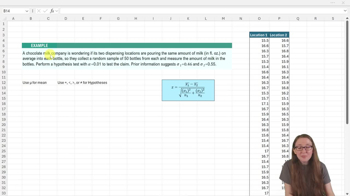
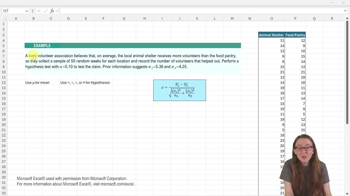
What formula is used to calculate the z-score for two means with known sigmas?
The formula is z = (x̄₁ - x̄₂) / sqrt(σ₁²/n₁ + σ₂²/n₂).
Which Excel function is used to calculate the sample mean from data?
The function is =AVERAGE(range).
How do you calculate the numerator for the z-score in Excel?
Subtract the second sample mean from the first: x̄₁ - x̄₂.
How do you calculate σ₁²/n₁ in Excel?
Square sigma1, then divide by n1: =sigma1^2/n1.
Which Excel function is used to find the cumulative left-tail probability for a z-score?
Use =NORM.S.DIST(z, TRUE).
What does the p-value represent in hypothesis testing?
The p-value is the probability of observing a test statistic as extreme as, or more extreme than, the one calculated, assuming the null hypothesis is true.
What decision do you make if the p-value is less than alpha?
You reject the null hypothesis.
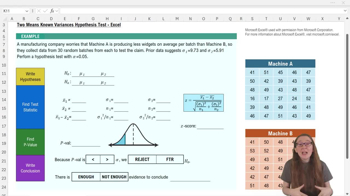
In the example, what were the sample sizes for both groups?
Both sample sizes were 30 (n₁ = 30, n₂ = 30).
What were the values of sigma1 and sigma2 in the example?
Sigma1 was 9.73 and sigma2 was 5.91.
If your alternative hypothesis uses a less than symbol, which tail probability do you use?
You use the left-tail probability.
What conclusion was reached in the example when the p-value was 0.04 and alpha was 0.05?
The null hypothesis was rejected, indicating enough evidence that machine A produces less on average than machine B.
Why is it helpful to break the z-score formula into parts when calculating in Excel?
Breaking the formula into parts reduces the chance of making calculation errors and makes the process easier.
 Back
Back

 07:32
07:32