Skip to main content
Statistics for Business
My Course
Learn
Exam Prep
AI Tutor
Study Guides
Flashcards
Explore
Try the app
My Course
Learn
Exam Prep
AI Tutor
Study Guides
Flashcards
Explore
Try the app
Back
Two Means - Unknown, Equal Variance quiz
You can tap to flip the card.
What is the pooled standard deviation used for in hypothesis testing with two means?
You can tap to flip the card.
👆
What is the pooled standard deviation used for in hypothesis testing with two means?
It is a weighted average of the two sample variances, used to improve the accuracy of the test when population variances are assumed equal.
Track progress
Control buttons has been changed to "navigation" mode.
1/15
Related flashcards
Related practice
Recommended videos
Two Means - Unknown, Equal Variance definitions
Two Means - Unknown, Equal Variance
15 Terms
10. Hypothesis Testing for Two Samples
3 topics
15 problems
Chapter
Ally
Guided course
06:20
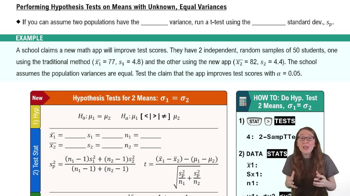
Means Unknown Equal Variances Hypothesis Test Using TI-84
117
views
Guided course
03:10
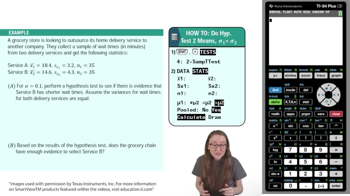
Means Unknown Equal Variances Hypothesis Test Using TI-84 Example 1
64
views
Guided course
03:34
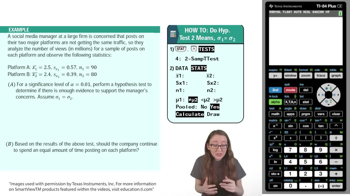
Means Unknown Equal Variances Hypothesis Test Using TI-84 Example 2
66
views
Terms in this set (15)
Hide definitions
What is the pooled standard deviation used for in hypothesis testing with two means?
It is a weighted average of the two sample variances, used to improve the accuracy of the test when population variances are assumed equal.
When can you assume equal variances in a two-sample t-test?
When the populations are similar enough that their variances can reasonably be considered the same.
What is the null hypothesis when testing two means with unknown but equal variances?
The null hypothesis is that the two population means are equal (μ1 = μ2).
How do you calculate degrees of freedom for the pooled t-test?
Add the sample sizes of both groups, subtract one from each, and then add those results together (n1-1) + (n2-1).
What is the formula for the test statistic in a pooled two-sample t-test?
t = (μ1 - μ2) / sp * sqrt(1/n1 + 1/n2), where sp is the pooled standard deviation.
What is the main advantage of using the pooled standard deviation?
It provides a better estimate of the population standard deviation, leading to more accurate hypothesis test results.
What must be true about the samples in a pooled two-sample t-test?
The samples must be independent and randomly selected.
What is the alternative hypothesis if you want to test if one mean is less than the other?
The alternative hypothesis is μ1 < μ2.
How do you decide whether to reject the null hypothesis in a pooled t-test?
Compare the p-value to the significance level (alpha); if the p-value is less than alpha, reject the null hypothesis.
What sample size condition allows you to use the normal approximation in a pooled t-test?
Each sample size should be greater than 30, or the data should be normally distributed.
What does a very small p-value indicate in the context of hypothesis testing?
It suggests strong evidence against the null hypothesis, supporting the alternative hypothesis.
What information do you need from each sample to perform a pooled t-test?
You need the sample mean, sample standard deviation, and sample size for each group.
What is the purpose of the pooled option on a calculator when performing a two-sample t-test?
Selecting 'pooled' tells the calculator to assume equal variances and use the pooled standard deviation in calculations.
If the p-value is 2.05 x 10^-7 and alpha is 0.05, what is the conclusion?
Reject the null hypothesis because the p-value is much smaller than alpha.
Why might professors allow technology use for pooled t-tests?
Because the calculations for the pooled standard deviation and test statistic can be complex and time-consuming by hand.
 BackBack
 06:20
06:20