Skip to main content
Statistics for Business
My Course
Learn
Exam Prep
AI Tutor
Study Guides
Flashcards
Explore
Try the app
My Course
Learn
Exam Prep
AI Tutor
Study Guides
Flashcards
Explore
Try the app
Back
Two Proportions definitions
You can tap to flip the card.
Null Hypothesis
You can tap to flip the card.
👆
Null Hypothesis
Default assumption that two population proportions are equal, often represented as p₁ = p₂.
Track progress
Control buttons has been changed to "navigation" mode.
1/15
Related flashcards
Related practice
Recommended videos
Two Proportions quiz
Two Proportions
15 Terms
Two Proportions
10. Hypothesis Testing for Two Samples
10 problems
Topic
Justin
10. Hypothesis Testing for Two Samples
3 topics
15 problems
Chapter
Ally
Guided course
10:28
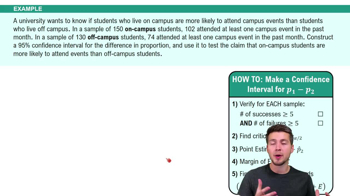
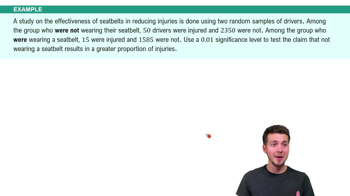
Difference in Proportions: Hypothesis Tests Example 1
186
views
3
rank
Guided course
09:24
Difference in Proportions: Confidence Intervals Example 2
142
views
2
rank
Guided course
05:01
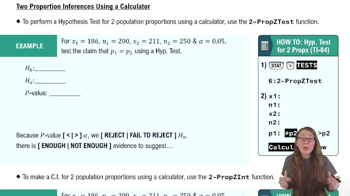
Two Proportions Inferences Using a TI-84
100
views
Terms in this set (15)
Hide definitions
Null Hypothesis
Default assumption that two population proportions are equal, often represented as p₁ = p₂.
Alternative Hypothesis
Statement suggesting a difference exists between two population proportions, such as p₁ ≠ p₂.
Test Statistic
Value, typically a z-score, calculated to measure the difference between sample proportions relative to expected variation.
P-value
Probability of observing a test statistic as extreme as, or more extreme than, the one calculated, assuming the null hypothesis is true.
Significance Level
Threshold, often denoted alpha, used to decide whether to reject the null hypothesis, such as 0.05.
Confidence Interval
Range of values, based on sample data, likely to contain the true difference between population proportions.
Point Estimate
Best guess for the difference between two population proportions, calculated from sample data.
Margin of Error
Amount added and subtracted from the point estimate to create the confidence interval, reflecting sampling variability.
Critical Value
Z-score corresponding to the desired confidence level, used in constructing confidence intervals.
Pooled Proportion
Weighted average of sample proportions, combining successes and trials from both groups for hypothesis testing.
Random Sampling
Method ensuring each subject in the population has an equal chance of selection, supporting valid inference.
Independence
Condition where the outcome of one sample does not affect the outcome of the other, required for valid results.
Successes and Failures Condition
Requirement that each sample has at least five successes and five failures to justify normal approximation.
Two-tailed Test
Hypothesis test considering deviations in both directions from the null value, often used with p₁ ≠ p₂.
TI-84 Calculator
Tool used to perform hypothesis tests and construct confidence intervals for two proportions efficiently.
 BackBack

 10:28
10:28