Skip to main content
Statistics for Business
My Course
Learn
Exam Prep
AI Tutor
Study Guides
Flashcards
Explore
Try the app
My Course
Learn
Exam Prep
AI Tutor
Study Guides
Flashcards
Explore
Try the app
Back
Two Variances and F Distribution quiz
You can tap to flip the card.
What distribution is used for two-sample hypothesis tests for variance?
You can tap to flip the card.
👆
What distribution is used for two-sample hypothesis tests for variance?
The F-distribution is used for two-sample hypothesis tests for variance.
Track progress
Control buttons has been changed to "navigation" mode.
1/15
Related flashcards
Related practice
Recommended videos
Two Variances and F Distribution definitions
Two Variances and F Distribution
15 Terms
10. Hypothesis Testing for Two Samples
3 topics
15 problems
Chapter
Ally
Guided course
05:42
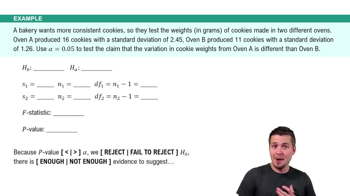
Performing Hypothesis Tests for Two Variances Example 2
57
views
Guided course
06:25
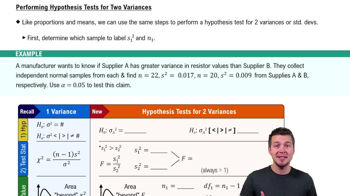
Performing Hypothesis Tests for Two Variances
70
views
Guided course
04:02
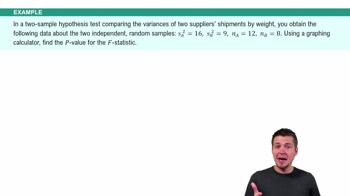
The F-Distribution Example 1
69
views
Terms in this set (15)
Hide definitions
What distribution is used for two-sample hypothesis tests for variance?
The F-distribution is used for two-sample hypothesis tests for variance.
How is the F statistic calculated in a two-sample variance test?
The F statistic is calculated as the ratio of the two sample variances, s1 squared over s2 squared.
What rule should you follow when assigning s1 squared and s2 squared in the F statistic?
s1 squared should always be the larger sample variance, and s2 squared the smaller, when setting up the F statistic.
What are the degrees of freedom for the numerator and denominator in the F-distribution?
The numerator's degrees of freedom are n1 minus 1, and the denominator's are n2 minus 1.
What is the null hypothesis typically in a two-sample variance test?
The null hypothesis is that the two population variances are equal.
What is the shape of the F-distribution?
The F-distribution is asymmetric and right-skewed.
How do you find the p-value for an F statistic using a graphing calculator?
You use the Fcdf function, entering the F statistic as the lower bound, a large number as the upper bound, and the two degrees of freedom.
What does it mean if the calculated p-value is greater than the significance level alpha?
If the p-value is greater than alpha, you fail to reject the null hypothesis.
What assumptions must be met for a valid two-sample variance test?
Samples must be independent, random, and drawn from normally distributed populations.
What is the critical value approach in the F-distribution test?
The critical value approach involves comparing the F statistic to a value from F tables based on alpha and degrees of freedom.
Why is the F statistic usually greater than one in these tests?
Because s1 squared is set as the larger variance, the ratio s1 squared over s2 squared is usually greater than one.
What is the alternative hypothesis if you want to test if one variance is greater than the other?
The alternative hypothesis is that one population variance is greater than the other (e.g., sigma_a squared > sigma_b squared).
What is the main difference between the chi-squared and F-distributions in variance testing?
The chi-squared distribution is used for one-sample variance tests, while the F-distribution is used for two-sample variance tests.
What is the first step before setting up hypotheses in a two-sample variance test?
The first step is to identify which sample has the larger variance and assign it as s1 squared.
What does the area to the right of the F statistic in the F-distribution represent?
It represents the p-value, or the probability of observing an F statistic as extreme or more extreme under the null hypothesis.
 BackBack
 05:42
05:42