Skip to main content
Statistics for Business
My Course
Learn
Exam Prep
AI Tutor
Study Guides
Flashcards
Explore
Try the app
My Course
Learn
Exam Prep
AI Tutor
Study Guides
Flashcards
Explore
Try the app
Back
Two-Way ANOVA quiz
You can tap to flip the card.
What does two-way ANOVA analyze?
You can tap to flip the card.
👆
What does two-way ANOVA analyze?
Two-way ANOVA analyzes the effects of two factors on a dependent variable and tests for interaction effects between those factors.
Track progress
Control buttons has been changed to "navigation" mode.
1/15
Related flashcards
Related practice
Recommended videos
Two-Way ANOVA definitions
Two-Way ANOVA
15 Terms
14. ANOVA
1 topic
15 problems
Chapter
Ally
Guided course
08:17
Intro to Two-Way ANOVA & Two-Way Tables
96
views
1
rank
Guided course
06:35
Two-Way ANOVA: Interaction Plots
74
views
Guided course
05:00
Intro to Two-Way ANOVA & Two-Way Tables Example 1
77
views
1
rank
Terms in this set (15)
Hide definitions
What does two-way ANOVA analyze?
Two-way ANOVA analyzes the effects of two factors on a dependent variable and tests for interaction effects between those factors.
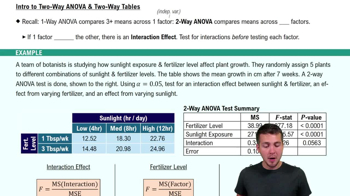
What is an interaction effect in two-way ANOVA?
An interaction effect occurs when the impact of one factor on the dependent variable depends on the level of the other factor.
What is the null hypothesis when testing for interaction effects in two-way ANOVA?
The null hypothesis states that there is no interaction between the two factors.
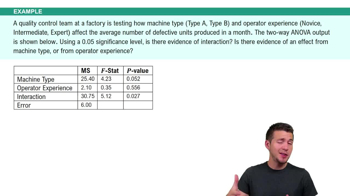
What statistical values are used to determine significance in two-way ANOVA?
F-statistics and p-values are used to determine significance at a chosen alpha level.
What does it mean if the p-value for interaction is greater than the alpha level?
If the p-value is greater than alpha, you fail to reject the null hypothesis, indicating no evidence of interaction.
What is the dependent variable in a two-way ANOVA experiment?
The dependent variable is the outcome being measured, such as plant growth or exam scores.
What is the first test you should perform in a two-way ANOVA?
You should first test for interaction effects before testing the effects of each individual factor.
What happens if there is a significant interaction effect in two-way ANOVA?
If there is a significant interaction, you cannot proceed with testing the individual effects of each factor independently.
How is the F-statistic for interaction calculated in two-way ANOVA?
The F-statistic for interaction is calculated as the ratio of mean squares due to interaction to mean squares due to error.
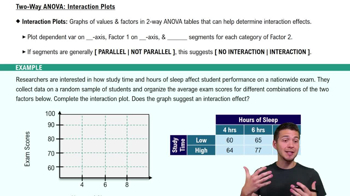
What is the purpose of an interaction plot in two-way ANOVA?
An interaction plot visually assesses whether there is an interaction effect by comparing the parallelism of lines representing factor levels.
What does it indicate if lines in an interaction plot are parallel?
Parallel lines suggest that the factors are independent and there is no interaction effect.
What does it indicate if lines in an interaction plot are not parallel?
Non-parallel lines indicate that there is an interaction effect between the factors.
How do you test the effect of a single factor in two-way ANOVA after finding no interaction?
You use an F-statistic to compare the mean squares for that factor to the mean squares due to error, similar to one-way ANOVA.
What is the null hypothesis when testing the effect of a single factor in two-way ANOVA?
The null hypothesis states that there is no difference in means due to that factor.
What should you conclude if the p-value for a factor is less than the alpha level in two-way ANOVA?
If the p-value is less than alpha, you reject the null hypothesis and conclude there is evidence of a difference in means due to that factor.
 BackBack
 08:17
08:17