Skip to main content
Statistics for Business
My Course
Learn
Exam Prep
AI Tutor
Study Guides
Flashcards
Explore
Try the app
My Course
Learn
Exam Prep
AI Tutor
Study Guides
Flashcards
Explore
Try the app
Back
Type I & Type II Errors definitions
You can tap to flip the card.
Null Hypothesis
You can tap to flip the card.
👆
Null Hypothesis
Initial assumption in a test, often representing no effect or status quo, which is evaluated against sample data.
Track progress
Control buttons has been changed to "navigation" mode.
1/14
Related flashcards
Related practice
Recommended videos
Type I & Type II Errors quiz
Type I & Type II Errors
15 Terms
9. Hypothesis Testing for One Sample
3 topics
15 problems
Chapter
Brendan
Guided course
03:21
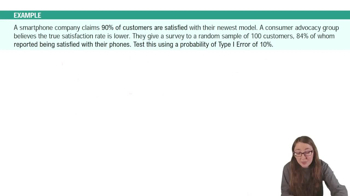
Type I & Type II Errors Example 1
74
views
1
rank
Guided course
06:02
Type I & Type II Errors
87
views
Terms in this set (14)
Hide definitions
Null Hypothesis
Initial assumption in a test, often representing no effect or status quo, which is evaluated against sample data.
Alternative Hypothesis
Statement opposing the initial assumption, suggesting a different effect or outcome in the population.
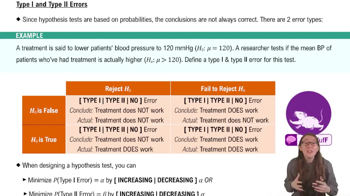
Type I Error
Mistake made when evidence leads to rejecting a correct initial assumption, often linked to the significance threshold.
Type II Error
Mistake made when evidence fails to challenge an incorrect initial assumption, potentially missing a real effect.
Alpha
Threshold probability set before testing, representing the maximum risk accepted for wrongly rejecting the initial assumption.
Beta
Probability of not detecting a real effect, representing the risk of failing to challenge an incorrect initial assumption.
P Value
Calculated probability indicating how likely observed data would occur if the initial assumption were true.
Significance Level
Pre-determined cutoff used to decide whether evidence is strong enough to challenge the initial assumption.
Hypothesis Test
Structured procedure for using sample data to evaluate competing claims about a population.
Sample Data
Observed values collected from a subset of the population, used to draw conclusions about broader trends.
Experimental Design
Planned approach for collecting and analyzing data to answer specific research questions or test claims.
Ethical Considerations
Moral factors influencing decisions about which risks or mistakes are more acceptable in research conclusions.
Probability
Numerical measure of how likely an event or outcome is to occur, central to evaluating risks in testing.
Treatment Efficacy
Effectiveness of an intervention, often the focus of claims tested in medical or scientific studies.
 BackBack
 03:21
03:21