64–68. Shell method Use the shell method to find the volume of the following solids.
A hole of radius r≤R is drilled symmetrically along the axis of a bullet. The bullet is formed by revolving the parabola y = 6(1−x²/R²) about the y-axis, where 0≤x≤R.
Verified step by step guidance
1
Step 1: Understand the shell method. The shell method calculates the volume of a solid of revolution by integrating the lateral surface area of cylindrical shells. The formula for the shell method is: \( V = \int_{a}^{b} 2\pi x \cdot h(x) \, dx \), where \( x \) is the radius of the shell and \( h(x) \) is the height of the shell.
Step 2: Identify the height function \( h(x) \). The height of the shell is determined by the parabola \( y = 6(1 - x^2/R^2) \). Since the solid is revolved around the y-axis, \( h(x) = y \). Thus, \( h(x) = 6(1 - x^2/R^2) \).
Step 3: Determine the limits of integration. The parabola is defined for \( 0 \leq x \leq R \), and the hole is drilled symmetrically along the axis. Therefore, the limits of integration are \( x = r \) to \( x = R \), where \( r \) is the radius of the hole.
Step 4: Set up the integral for the volume. Using the shell method formula, the volume is given by: \( V = \int_{r}^{R} 2\pi x \cdot h(x) \, dx \). Substituting \( h(x) = 6(1 - x^2/R^2) \), the integral becomes: \( V = \int_{r}^{R} 2\pi x \cdot 6(1 - x^2/R^2) \, dx \).
Step 5: Simplify the integral expression. Expand the integrand: \( V = \int_{r}^{R} 12\pi x - \frac{12\pi x^3}{R^2} \, dx \). This integral can now be solved by integrating each term separately. The first term involves \( \int x \, dx \), and the second term involves \( \int x^3 \, dx \).
Verified video answer for a similar problem:
This video solution was recommended by our tutors as helpful for the problem above
Video duration:
4m
Play a video:
0 Comments
Key Concepts
Here are the essential concepts you must grasp in order to answer the question correctly.
Shell Method
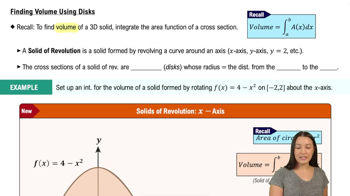
The shell method is a technique for finding the volume of a solid of revolution. It involves integrating the lateral surface area of cylindrical shells formed by revolving a region around an axis. The formula for the volume using the shell method is V = 2π ∫ (radius)(height) dx, where the radius is the distance from the axis of rotation and the height is the function value.
The volume of revolution refers to the volume of a three-dimensional shape created by rotating a two-dimensional shape around an axis. This concept is fundamental in calculus, as it allows for the calculation of volumes using integration techniques. Common methods for finding these volumes include the disk method and the shell method, each suited for different scenarios based on the axis of rotation.
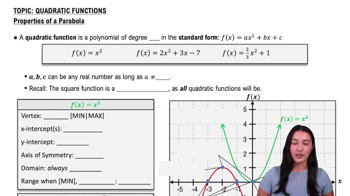
A parabola is a symmetric curve defined by a quadratic function, which in this case is given by y = 6(1 - x²/R²). Understanding the properties of parabolas, such as their vertex, axis of symmetry, and how they behave when revolved around an axis, is crucial for applying the shell method effectively. The specific parabola in the question describes a shape that, when revolved, creates a solid with a distinct volume.