Case 2 of the general solution Solve the equation y′(t) = ky + b in the case that ky + b < 0 and verify that the general solution is y(t) = Ceᵏᵗ − b/k.
Table of contents
- 0. Functions7h 55m
- Introduction to Functions18m
- Piecewise Functions10m
- Properties of Functions9m
- Common Functions1h 8m
- Transformations5m
- Combining Functions27m
- Exponent rules32m
- Exponential Functions28m
- Logarithmic Functions24m
- Properties of Logarithms36m
- Exponential & Logarithmic Equations35m
- Introduction to Trigonometric Functions38m
- Graphs of Trigonometric Functions44m
- Trigonometric Identities47m
- Inverse Trigonometric Functions48m
- 1. Limits and Continuity2h 2m
- 2. Intro to Derivatives1h 33m
- 3. Techniques of Differentiation3h 18m
- 4. Applications of Derivatives2h 38m
- 5. Graphical Applications of Derivatives6h 2m
- 6. Derivatives of Inverse, Exponential, & Logarithmic Functions2h 37m
- 7. Antiderivatives & Indefinite Integrals1h 26m
- 8. Definite Integrals4h 44m
- 9. Graphical Applications of Integrals2h 27m
- 10. Physics Applications of Integrals 3h 16m
- 11. Integrals of Inverse, Exponential, & Logarithmic Functions2h 31m
- 12. Techniques of Integration7h 41m
- 13. Intro to Differential Equations2h 55m
- 14. Sequences & Series5h 36m
- 15. Power Series2h 19m
- 16. Parametric Equations & Polar Coordinates7h 58m
13. Intro to Differential Equations
Separable Differential Equations
Problem 9.4.31b
Textbook Question
{Use of Tech} Intravenous drug dosing The amount of drug in the blood of a patient (in milligrams) administered via an intravenous line is governed by the initial value problem y’(t) = -0.02y + 3, y(0) = 0 where t is measured in hours.
b. What is the steady-state level of the drug?
Verified step by step guidance1
Recognize that the steady-state level of the drug corresponds to the equilibrium solution where the amount of drug no longer changes over time. Mathematically, this means setting the derivative \(y'(t)\) to zero: \$0 = -0.02y + 3$.
Solve the equation \$0 = -0.02y + 3\( for \)y\( to find the steady-state concentration. Rearrange it to isolate \)y\(: \)0.02y = 3$.
Divide both sides of the equation by \$0.02\( to solve for \)y$: \(y = \frac{3}{0.02}\).
Interpret this value as the long-term amount of drug in the blood when the system reaches equilibrium, meaning the drug input and elimination balance out.
Note that this steady-state value is independent of the initial condition \(y(0) = 0\) because it represents the behavior as \(t \to \infty\).
Verified video answer for a similar problem:This video solution was recommended by our tutors as helpful for the problem above
Video duration:
1mPlay a video:
0 Comments
Key Concepts
Here are the essential concepts you must grasp in order to answer the question correctly.
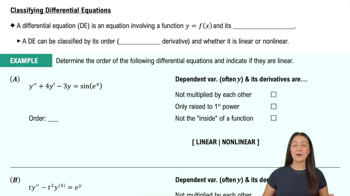
First-Order Linear Differential Equations
This type of differential equation has the form y' + p(t)y = q(t). It models processes where the rate of change depends linearly on the current state and an external input. Solving such equations involves finding an integrating factor or using steady-state analysis.
Recommended video:
Classifying Differential Equations
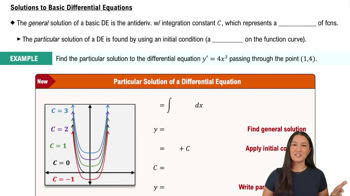
Steady-State Solution
The steady-state level is the long-term behavior of the system when the rate of change becomes zero (y' = 0). It represents the equilibrium concentration where the drug input balances the elimination, providing a constant drug level in the blood.
Recommended video:
Solutions to Basic Differential Equations
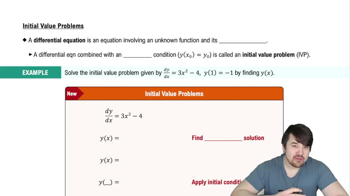
Initial Value Problem (IVP)
An IVP specifies a differential equation along with an initial condition, y(0) = y0, which allows for a unique solution. It models real-world scenarios where the starting state is known, such as the initial drug concentration at time zero.
Recommended video:
Initial Value Problems
Related Videos
Related Practice
Textbook Question
36
views