{Use of Tech} Bessel functions Bessel functions arise in the study of wave propagation in circular geometries (for example, waves on a circular drum head). They are conveniently defined as power series. One of an infinite family of Bessel functions is J₀(x) = ∑ₖ₌₀∞ (−1)ᵏ/(2²ᵏ(k!)²) x²ᵏ b. Find the radius and interval of convergence of the power series for J₀.
Verified step by step guidance
1
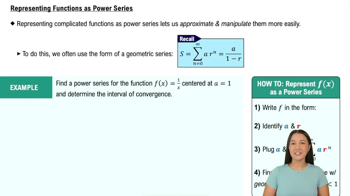
Identify the given power series for the Bessel function \(J_0(x)\):
\[J_0(x) = \sum_{k=0}^\infty \frac{(-1)^k}{2^{2k} (k!)^2} x^{2k}\]
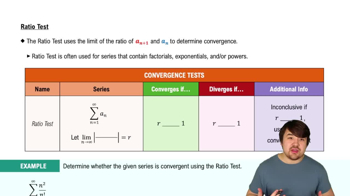
To find the radius of convergence, apply the Ratio Test to the general term
\[a_k = \frac{(-1)^k}{2^{2k} (k!)^2} x^{2k}\]
Calculate the limit:
\[L = \lim_{k \to \infty} \left| \frac{a_{k+1}}{a_k} \right|\]
Substitute \(a_{k+1}\) and \(a_k\) into the ratio:
\[\left| \frac{a_{k+1}}{a_k} \right| = \left| \frac{(-1)^{k+1}}{2^{2(k+1)} ((k+1)!)^2} x^{2(k+1)} \cdot \frac{2^{2k} (k!)^2}{(-1)^k x^{2k}} \right| = \left| \frac{x^2}{4} \cdot \frac{(k!)^2}{((k+1)!)^2} \right|\]
Simplify the factorial expression:
\[\frac{(k!)^2}{((k+1)!)^2} = \frac{(k!)^2}{(k+1)^2 (k!)^2} = \frac{1}{(k+1)^2}\]
So the ratio becomes:
\[\left| \frac{a_{k+1}}{a_k} \right| = \left| \frac{x^2}{4 (k+1)^2} \right|\]
Take the limit as \(k \to \infty\):
\[L = \lim_{k \to \infty} \left| \frac{x^2}{4 (k+1)^2} \right| = 0\]
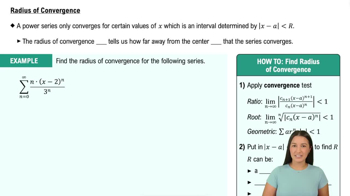
Since \(L = 0\) for all real \(x\), the series converges for all \(x\). Therefore, the radius of convergence is infinite, and the interval of convergence is \((-\infty, \infty)\).
Verified video answer for a similar problem:
This video solution was recommended by our tutors as helpful for the problem above
Video duration:
4m
Play a video:
0 Comments
Key Concepts
Here are the essential concepts you must grasp in order to answer the question correctly.
Power Series and Radius of Convergence
A power series is an infinite sum of terms involving powers of a variable, typically centered at zero or another point. The radius of convergence is the distance from the center within which the series converges absolutely. It can be found using tests like the Ratio Test or Root Test, which analyze the behavior of the series' terms as the index approaches infinity.
The Ratio Test determines the convergence of a series by examining the limit of the absolute value of the ratio of consecutive terms. If this limit is less than one, the series converges absolutely; if greater than one, it diverges. For power series, this test helps find the radius of convergence by setting the limit equal to one and solving for the variable.
Bessel functions, like J₀(x), are special functions defined by infinite power series with factorial terms and alternating signs. Understanding their series representation is crucial for analyzing convergence properties. These functions often arise in physical problems with circular symmetry, and their series form allows for practical computation and convergence analysis.