
Identify the symmetry (if any) in the graphs of the following equations. y2−4x2=4
Verified step by step guidance
1
First, recognize that the given equation is in the form of a conic section. Specifically, it resembles the equation of a hyperbola: \( y^2 - 4x^2 = 4 \).
To analyze symmetry, consider the standard forms of symmetry: symmetry about the x-axis, y-axis, and the origin. For hyperbolas, symmetry is typically about the axes or the origin.
Check for symmetry about the x-axis by replacing \( y \) with \( -y \) in the equation. Substitute \( -y \) into the equation: \( (-y)^2 - 4x^2 = 4 \). Simplify to see if the equation remains unchanged.
Check for symmetry about the y-axis by replacing \( x \) with \( -x \) in the equation. Substitute \( -x \) into the equation: \( y^2 - 4(-x)^2 = 4 \). Simplify to see if the equation remains unchanged.
Check for symmetry about the origin by replacing both \( x \) with \( -x \) and \( y \) with \( -y \). Substitute into the equation: \( (-y)^2 - 4(-x)^2 = 4 \). Simplify to see if the equation remains unchanged. Analyze the results to determine the symmetry of the graph.
Verified video answer for a similar problem:
This video solution was recommended by our tutors as helpful for the problem above
Video duration:
4m
Play a video:
0 Comments
Key Concepts
Here are the essential concepts you must grasp in order to answer the question correctly.
Symmetry in Graphs
Symmetry in graphs refers to the property where a graph remains unchanged under certain transformations, such as reflection or rotation. Common types of symmetry include even symmetry (about the y-axis), odd symmetry (about the origin), and symmetry about a line. Identifying symmetry helps in understanding the behavior of functions and their graphs.
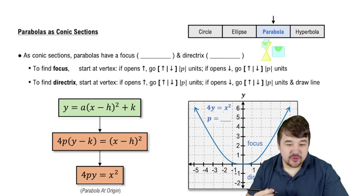
Conic sections are the curves obtained by intersecting a plane with a double-napped cone. The equation given, y² - 4x² = 4, represents a hyperbola, which is characterized by its two branches that open away from each other. Understanding the properties of conic sections is essential for analyzing their graphs and symmetries.
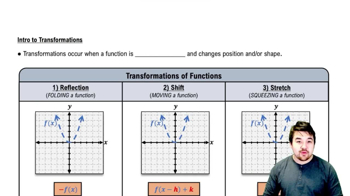
Transformations of functions involve shifting, reflecting, stretching, or compressing the graph of a function. For example, replacing y with -y reflects the graph across the x-axis, while replacing x with -x reflects it across the y-axis. These transformations are crucial for determining the symmetry of a graph, as they can reveal how the graph behaves under various operations.