The parabola y=x²+1 consists of two one-to-one functions, g₁(x) and g₂(x). Complete each exercise and confirm that your answers are consistent with the graphs displayed in the figure. <IMAGE>
Find formulas for g₁((x) and g₁⁻¹(x). State the domain and range of each function.
Verified step by step guidance
1
Step 1: Identify the one-to-one functions from the parabola \( y = x^2 + 1 \). Since a parabola is symmetric about its vertex, we can split it into two functions: one for the left side and one for the right side. For the right side, where \( x \geq 0 \), the function is \( g_1(x) = x^2 + 1 \).
Step 2: Determine the inverse of \( g_1(x) \). To find \( g_1^{-1}(x) \), start by setting \( y = x^2 + 1 \) and solve for \( x \). Rearrange to get \( x^2 = y - 1 \), then take the square root: \( x = \sqrt{y - 1} \). Thus, \( g_1^{-1}(x) = \sqrt{x - 1} \).
Step 3: State the domain and range of \( g_1(x) \). Since \( g_1(x) = x^2 + 1 \) and we are considering \( x \geq 0 \), the domain of \( g_1(x) \) is \([0, \infty)\). The range is \([1, \infty)\) because the smallest value of \( x^2 + 1 \) is 1 when \( x = 0 \).
Step 4: State the domain and range of \( g_1^{-1}(x) \). The domain of \( g_1^{-1}(x) = \sqrt{x - 1} \) is \([1, \infty)\) because the expression under the square root, \( x - 1 \), must be non-negative. The range is \([0, \infty)\) because the square root function outputs non-negative values.
Step 5: Verify consistency with the graph. Check that the domain and range of \( g_1(x) \) and \( g_1^{-1}(x) \) match the sections of the parabola and its inverse on the graph. Ensure that \( g_1(x) \) covers the right side of the parabola and \( g_1^{-1}(x) \) reflects this section across the line \( y = x \).
Verified video answer for a similar problem:
This video solution was recommended by our tutors as helpful for the problem above
Video duration:
7m
Play a video:
0 Comments
Key Concepts
Here are the essential concepts you must grasp in order to answer the question correctly.
One-to-One Functions
A one-to-one function is a function where each output is produced by exactly one input. This means that if f(a) = f(b), then a must equal b. For the parabola y = x² + 1, it is not one-to-one over its entire domain, but can be restricted to intervals where it is, allowing for the definition of inverse functions.
An inverse function essentially reverses the effect of the original function. If g(x) is a function, then its inverse g⁻¹(x) satisfies the condition g(g⁻¹(x)) = x for all x in the domain of g⁻¹. To find the inverse of a one-to-one function, you typically swap the x and y variables and solve for y.
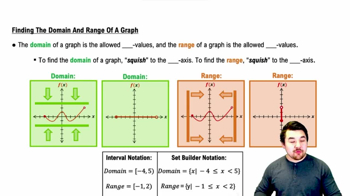
The domain of a function is the set of all possible input values (x-values) that the function can accept, while the range is the set of all possible output values (y-values) that the function can produce. For the functions g₁(x) and g₂(x) derived from the parabola, understanding their domains and ranges is crucial for accurately defining their behavior and ensuring the validity of their inverses.

 7:41 minutes
 Verified step by step guidance

 05:50
05:50