Exercises 45–48 give the acceleration a=d²s/dt², initial velocity, and initial position of an object moving on a coordinate line. Find the object’s position at time t.
a = 9.8, v(0) = −3, s(0) = 0
Verified step by step guidance
1
Start by integrating the acceleration function a(t) = 9.8 with respect to time t to find the velocity function v(t). This involves finding the antiderivative of a constant function.
The antiderivative of a constant 9.8 is 9.8t. Therefore, v(t) = 9.8t + C, where C is the constant of integration.
Use the initial condition v(0) = -3 to solve for the constant C. Substitute t = 0 and v(0) = -3 into the velocity equation: -3 = 9.8(0) + C.
Solve for C to find that C = -3. Thus, the velocity function is v(t) = 9.8t - 3.
Integrate the velocity function v(t) = 9.8t - 3 with respect to time t to find the position function s(t). Use the initial condition s(0) = 0 to solve for the constant of integration in the position function.
Verified video answer for a similar problem:
This video solution was recommended by our tutors as helpful for the problem above
Video duration:
6m
Play a video:
0 Comments
Key Concepts
Here are the essential concepts you must grasp in order to answer the question correctly.
Integration
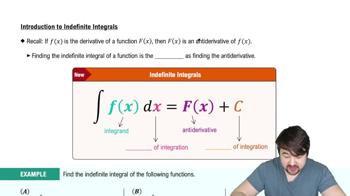
Integration is the process of finding the antiderivative or the area under a curve. In this context, it is used to find the velocity function from the acceleration function by integrating acceleration with respect to time. This step is crucial for determining the velocity at any given time.
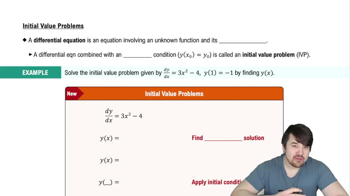
Initial conditions are values given at the start of a problem that help determine the specific solution to a differential equation. Here, the initial velocity v(0) = -3 and initial position s(0) = 0 are used to find the constants of integration when solving for velocity and position functions.
The position function s(t) describes the location of an object at any time t. It is found by integrating the velocity function, which itself is derived from the acceleration function. The position function is essential for understanding the object's movement over time and is determined using integration and initial conditions.