Step 1: Understand the piecewise function. The function f(x) is defined as f(x) = x^3 + 4x + 1 for x \(\leq\) 0 and f(x) = 2x^3 for x > 0.
Step 2: Determine the continuity at the point where the function changes, which is at x = 0.
Step 3: Check the left-hand limit as x approaches 0 from the left (x \(\to\) 0^-). Calculate \(\lim\)_{x \(\to\) 0^-} (x^3 + 4x + 1).
Step 4: Check the right-hand limit as x approaches 0 from the right (x \(\to\) 0^+). Calculate \(\lim\)_{x \(\to\) 0^+} (2x^3).
Step 5: Compare the left-hand limit, right-hand limit, and the value of the function at x = 0 to determine if the function is continuous at x = 0. If all are equal, the function is continuous at x = 0. Otherwise, it is not.
Verified video answer for a similar problem:
This video solution was recommended by our tutors as helpful for the problem above
Video duration:
4m
Play a video:
0 Comments
Key Concepts
Here are the essential concepts you must grasp in order to answer the question correctly.
Continuity of Functions
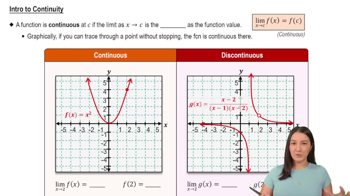
A function is continuous at a point if the limit of the function as it approaches that point equals the function's value at that point. For a function to be continuous over an interval, it must be continuous at every point within that interval. This concept is crucial for determining where a function does not have breaks, jumps, or asymptotes.
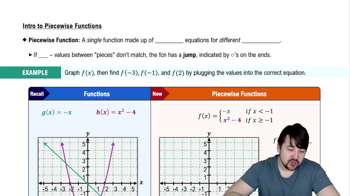
Piecewise functions are defined by different expressions based on the input value. In this case, the function f(x) has two distinct expressions depending on whether x is less than or equal to zero or greater than zero. Understanding how to analyze each piece separately is essential for determining the overall continuity of the function.
Limits are fundamental in calculus for understanding the behavior of functions as they approach specific points. To assess continuity at the boundary point (x=0) of the piecewise function, one must evaluate the left-hand limit and the right-hand limit. If both limits exist and are equal to the function's value at that point, the function is continuous there.