Differentials Consider the following functions and express the relationship between a small change in x and the corresponding change in y in the form dy = f'(x)dx.
f(x) = 2x + 1
Verified step by step guidance
1
First, understand that the differential dy represents the change in the function y = f(x) when x changes by a small amount dx.
To find dy, we need to determine the derivative of the function f(x) with respect to x, which is denoted as f'(x).
Given the function f(x) = 2x + 1, calculate the derivative f'(x). Since the derivative of a constant is 0 and the derivative of 2x is 2, we have f'(x) = 2.
Now, express the relationship between the small change in x (dx) and the corresponding change in y (dy) using the formula dy = f'(x)dx.
Substitute the derivative f'(x) = 2 into the formula to get dy = 2dx, which shows how a small change in x affects the change in y.
Verified video answer for a similar problem:
This video solution was recommended by our tutors as helpful for the problem above
Video duration:
1m
Play a video:
0 Comments
Key Concepts
Here are the essential concepts you must grasp in order to answer the question correctly.
Differentials
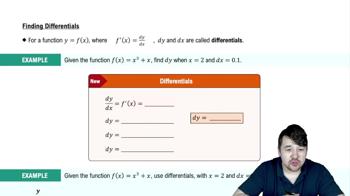
Differentials represent the infinitesimal changes in variables. In calculus, if y is a function of x, the differential dy is defined as the product of the derivative f'(x) and the differential dx, which represents a small change in x. This relationship helps in approximating how a small change in the input (x) affects the output (y).
The derivative of a function, denoted as f'(x), measures the rate at which the function's value changes as its input changes. It is defined as the limit of the average rate of change of the function over an interval as the interval approaches zero. In the context of differentials, the derivative provides the slope of the tangent line to the function at a given point, which is crucial for understanding how y changes with respect to x.
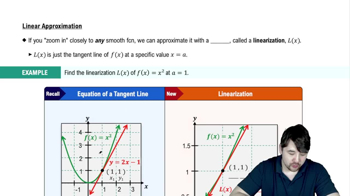
Linear approximation is a method used to estimate the value of a function near a given point using the tangent line at that point. It is based on the idea that for small changes in x, the change in y can be approximated by the product of the derivative and the change in x. This concept is essential for understanding how to express the relationship between small changes in x and y using the differential equation dy = f'(x)dx.

 1:29 minutes
 Verified step by step guidance
 05:53
05:53