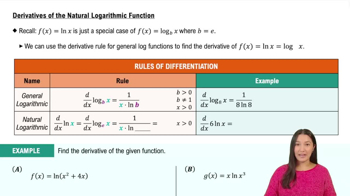
Find the derivative of the following functions. y = In √x⁴+x²
Verified step by step guidance
1
Step 1: Recognize that the function y = ln(√(x⁴ + x²)) can be rewritten using properties of logarithms and exponents. The square root can be expressed as a power of 1/2, so rewrite the function as y = ln((x⁴ + x²)^(1/2)).
Step 2: Apply the logarithmic identity ln(a^b) = b * ln(a) to simplify the expression. This gives y = (1/2) * ln(x⁴ + x²).
Step 3: Differentiate the function using the chain rule. The derivative of y with respect to x is dy/dx = (1/2) * d/dx[ln(x⁴ + x²)].
Step 4: Use the derivative of the natural logarithm function, which is d/dx[ln(u)] = (1/u) * du/dx, where u = x⁴ + x². First, find du/dx, which is the derivative of x⁴ + x² with respect to x.
Step 5: Calculate du/dx by differentiating each term separately: the derivative of x⁴ is 4x³ and the derivative of x² is 2x. Therefore, du/dx = 4x³ + 2x. Substitute this back into the expression for dy/dx to complete the differentiation process.
Verified video answer for a similar problem:
This video solution was recommended by our tutors as helpful for the problem above
Video duration:
7m
Play a video:
0 Comments
Key Concepts
Here are the essential concepts you must grasp in order to answer the question correctly.
Derivative
The derivative of a function measures how the function's output value changes as its input value changes. It is a fundamental concept in calculus, representing the slope of the tangent line to the curve of the function at any given point. The derivative is denoted as f'(x) or dy/dx and can be calculated using various rules such as the power rule, product rule, and chain rule.
The natural logarithm, denoted as ln, is the logarithm to the base e, where e is approximately equal to 2.71828. It is an important function in calculus, particularly in integration and differentiation. The natural logarithm has unique properties, such as ln(ab) = ln(a) + ln(b) and ln(a^b) = b*ln(a), which are useful when simplifying expressions before taking derivatives.
The chain rule is a fundamental technique in calculus used to differentiate composite functions. It states that if a function y is composed of two functions u and x (i.e., y = f(u) and u = g(x)), then the derivative of y with respect to x can be found by multiplying the derivative of f with respect to u by the derivative of g with respect to x. This rule is essential for handling functions that are nested within one another.

 7:13 minutes
 Verified step by step guidance
 05:44
05:44