7–64. Integration review Evaluate the following integrals. 51. ∫ from -1 to 0 of x / (x² + 2x + 2) dx
Verified step by step guidance
1
Step 1: Analyze the integrand. The given integral is ∫ from -1 to 0 of x / (x² + 2x + 2) dx. Notice that the denominator is a quadratic expression, x² + 2x + 2. Factorize or complete the square for the quadratic expression to simplify the integrand.
Step 2: Complete the square for the quadratic expression x² + 2x + 2. Rewrite it as (x + 1)² + 1. This helps us identify the structure of the denominator and suggests a substitution method.
Step 3: Use substitution to simplify the integral. Let u = x + 1, which implies du = dx. The limits of integration will change accordingly: when x = -1, u = 0; and when x = 0, u = 1. Rewrite the integral in terms of u.
Step 4: Substitute the completed square form into the integral. The integral becomes ∫ from 0 to 1 of (u - 1) / (u² + 1) du. Split the integrand into two parts: ∫ from 0 to 1 of u / (u² + 1) du and ∫ from 0 to 1 of -1 / (u² + 1) du.
Step 5: Solve each part of the integral separately. For ∫ u / (u² + 1) du, use the substitution v = u² + 1, dv = 2u du. For ∫ -1 / (u² + 1) du, recognize it as the standard arctangent formula. Combine the results to express the solution.
Verified video answer for a similar problem:
This video solution was recommended by our tutors as helpful for the problem above
Video duration:
7m
Play a video:
0 Comments
Key Concepts
Here are the essential concepts you must grasp in order to answer the question correctly.
Definite Integrals
A definite integral represents the signed area under a curve between two specified limits. In this case, the integral from -1 to 0 of the function x / (x² + 2x + 2) indicates that we are calculating the net area between the curve and the x-axis over that interval. The result of a definite integral is a numerical value that reflects this area.
To evaluate integrals, various techniques can be employed, such as substitution, integration by parts, or partial fraction decomposition. For the given integral, recognizing the form of the denominator (a quadratic expression) may suggest using substitution or completing the square to simplify the integration process. Mastery of these techniques is essential for solving more complex integrals.
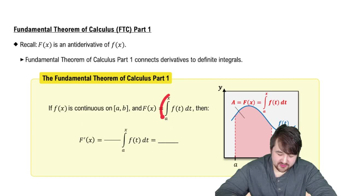
The Fundamental Theorem of Calculus links differentiation and integration, stating that if a function is continuous on an interval, the integral of its derivative over that interval equals the difference in the values of the original function at the endpoints. This theorem allows us to evaluate definite integrals by finding an antiderivative of the integrand and applying the limits of integration, which is crucial for solving the given problem.

 7:04 minutes
 Verified step by step guidance

 05:43
05:43