15–48. Derivatives Find the derivative of the following functions. y = 10^In 2x
Verified step by step guidance
1
Step 1: Recognize that the function y = 10^ln(2x) can be rewritten using the property of logarithms and exponents. Recall that ln(a^b) = b * ln(a), so we can express the function as y = e^(ln(10) * ln(2x)).
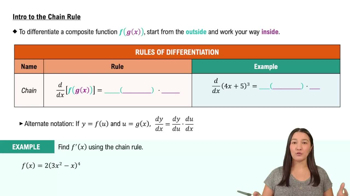
Step 2: Apply the chain rule to differentiate the function. The chain rule states that if you have a composite function y = f(g(x)), then the derivative y' = f'(g(x)) * g'(x). Here, let u = ln(10) * ln(2x), so y = e^u.
Step 3: Differentiate y = e^u with respect to u. The derivative of e^u with respect to u is e^u. Therefore, dy/du = e^u.
Step 4: Differentiate u = ln(10) * ln(2x) with respect to x. Use the product rule and the chain rule. The product rule states that if u = v * w, then du/dx = v' * w + v * w'. Here, v = ln(10) and w = ln(2x).
Step 5: Differentiate w = ln(2x) with respect to x. Use the chain rule: the derivative of ln(2x) is (1/(2x)) * (d/dx)(2x) = 1/x. Combine this with the previous steps to find the derivative of the original function.
Verified video answer for a similar problem:
This video solution was recommended by our tutors as helpful for the problem above
Video duration:
6m
Play a video:
0 Comments
Key Concepts
Here are the essential concepts you must grasp in order to answer the question correctly.
Derivatives
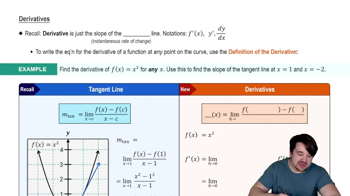
A derivative represents the rate at which a function changes at any given point. It is a fundamental concept in calculus that measures how a function's output value changes as its input value changes. The derivative can be interpreted as the slope of the tangent line to the curve of the function at a specific point.
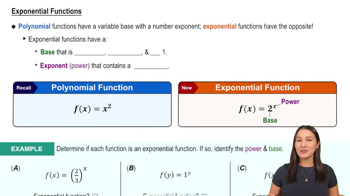
Exponential functions are mathematical expressions in the form of y = a^x, where 'a' is a constant and 'x' is the variable. In the context of derivatives, these functions have unique properties, such as their derivatives being proportional to the function itself. Understanding how to differentiate exponential functions is crucial for solving problems involving growth and decay.
The chain rule is a fundamental technique in calculus used to differentiate composite functions. It states that if a function y = f(g(x)) is composed of two functions, the derivative can be found by multiplying the derivative of the outer function f with the derivative of the inner function g. This rule is essential for handling functions where one function is nested within another.