Determine whether the following statements are true and give an explanation or counterexample. The line x=−1 is a vertical asymptote of the function f(x) =x^2 − 7x + 6 / x^2 − 1.
Verified step by step guidance
1
Step 1: Identify the function f(x) = \(\frac{x^2 - 7x + 6}{x^2 - 1}\). This is a rational function, which means it is a fraction where both the numerator and the denominator are polynomials.
Step 2: Determine the points where the denominator is zero, as these are potential vertical asymptotes. Set the denominator equal to zero: x^2 - 1 = 0.
Step 3: Solve the equation x^2 - 1 = 0. This can be factored as (x - 1)(x + 1) = 0, giving the solutions x = 1 and x = -1.
Step 4: Check if x = -1 is a vertical asymptote by ensuring it is not a removable discontinuity. Factor the numerator: x^2 - 7x + 6 = (x - 1)(x - 6).
Step 5: Since x = -1 does not cancel out with any factor in the numerator, it is indeed a vertical asymptote. Therefore, the statement is true.
Verified video answer for a similar problem:
This video solution was recommended by our tutors as helpful for the problem above
Video duration:
2m
Play a video:
0 Comments
Key Concepts
Here are the essential concepts you must grasp in order to answer the question correctly.
Vertical Asymptotes
A vertical asymptote occurs in a function when the function approaches infinity or negative infinity as the input approaches a certain value. This typically happens at values of x that make the denominator of a rational function equal to zero, provided that the numerator does not also equal zero at that point.
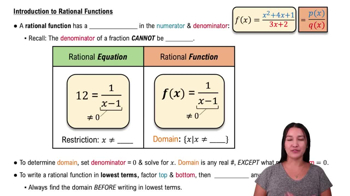
A rational function is a function that can be expressed as the ratio of two polynomials. The general form is f(x) = P(x)/Q(x), where P and Q are polynomials. Understanding the behavior of rational functions, especially their asymptotic behavior, is crucial for analyzing their graphs and determining points of discontinuity.
Factoring polynomials involves rewriting a polynomial as a product of its factors, which can simplify the analysis of functions. For example, the function f(x) = (x^2 - 7x + 6)/(x^2 - 1) can be factored to identify points where the function is undefined, helping to determine the presence of vertical asymptotes.