What are the two general ways in which an improper integral may occur?
Verified step by step guidance
1
Understand that an improper integral occurs when the integral does not meet the standard conditions for a definite integral, typically due to issues with the interval of integration or the integrand function.
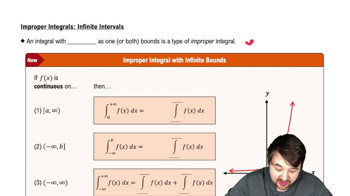
The first general way an improper integral may occur is when the interval of integration is infinite. For example, integrals with limits such as \(\int_a^{\infty} f(x) \, dx\) or \(\int_{-\infty}^b f(x) \, dx\) involve infinite limits.
The second general way an improper integral may occur is when the integrand has an infinite discontinuity (a vertical asymptote) at some point within the interval of integration. For example, if \(f(x)\) becomes unbounded at a point \(c\) in \([a,b]\), such as \(\int_a^b f(x) \, dx\) where \(f(x)\) approaches infinity as \(x\) approaches \(c\).
In both cases, the improper integral is evaluated by taking limits to handle the infinite behavior, such as \(\lim_{t \to \infty} \int_a^t f(x) \, dx\) or \(\lim_{t \to c^+} \int_a^t f(x) \, dx\) depending on the situation.
Recognizing these two types helps in determining the method to evaluate the integral and whether it converges or diverges.
Verified video answer for a similar problem:
This video solution was recommended by our tutors as helpful for the problem above
Video duration:
2m
Play a video:
0 Comments
Key Concepts
Here are the essential concepts you must grasp in order to answer the question correctly.
Improper Integrals with Infinite Limits
An improper integral occurs when the interval of integration is unbounded, such as integrating from a finite number to infinity or from negative infinity to infinity. In these cases, the integral is defined as a limit where the bound approaches infinity, allowing evaluation of areas under curves extending indefinitely.
Improper integrals can also arise when the integrand has one or more points of discontinuity within the interval of integration, especially if the function approaches infinity at those points. These integrals are evaluated by taking limits approaching the points of discontinuity to determine if the integral converges.
Determining whether an improper integral converges or diverges is essential. Convergence means the limit defining the integral exists and is finite, while divergence means the limit does not exist or is infinite. This concept helps decide if the integral represents a finite area or not.