A hemispherical bowl of radius 8 inches is filled to a depth of h inches, where 0≤h≤8 0 ≤ ℎ ≤ 8 . Find the volume of water in the bowl as a function of h. (Check the special cases h=0 and h=8.)
Verified step by step guidance
1
Step 1: Understand the geometry of the problem. The bowl is a hemisphere with radius 8 inches. The volume of water depends on the depth h, where 0 ≤ h ≤ 8. To find the volume as a function of h, we need to integrate the volume of thin horizontal slices of water from the bottom of the bowl up to the depth h.
Step 2: Set up the coordinate system. Place the center of the hemisphere at the origin (0, 0) in a 2D cross-section. The equation of the hemisphere in this coordinate system is x² + y² = r², where r = 8 inches. The water fills the bowl up to a height h, so we are interested in the region where y ranges from -8 to -8 + h.
Step 3: Express the radius of each horizontal slice of water. At a given height y, the radius of the slice is determined by the equation of the hemisphere: x² = r² - y². Thus, the radius of the slice is √(r² - y²).
Step 4: Calculate the volume of a thin horizontal slice. The volume of a thin slice at height y is the area of the circular cross-section (π * radius²) multiplied by the thickness dy. Substituting the radius, the volume of the slice is π * (r² - y²) dy.
Step 5: Integrate to find the total volume. To find the total volume of water up to depth h, integrate the volume of slices from y = -8 to y = -8 + h. The integral is V(h) = ∫[from y = -8 to y = -8 + h] π * (r² - y²) dy. Simplify the integral to express the volume as a function of h.
Verified video answer for a similar problem:
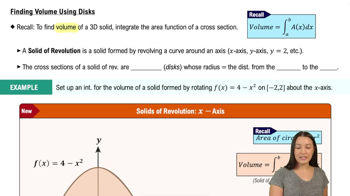
This video solution was recommended by our tutors as helpful for the problem above
Video duration:
4m
Play a video:
0 Comments
Key Concepts
Here are the essential concepts you must grasp in order to answer the question correctly.
Volume of a Sphere
The volume of a sphere is calculated using the formula V = (4/3)πr³, where r is the radius. For a hemisphere, the volume is half of that, V = (2/3)πr³. Understanding this formula is essential for determining the volume of water in the hemispherical bowl as the depth changes.
The cross-sectional area of a shape is the area of a slice taken perpendicular to a given axis. In this problem, the cross-section of the water in the bowl at a depth h can be represented as a circle, and its area can be calculated using A = πr², where r is the radius of the circular cross-section at that depth.
Integration is a fundamental concept in calculus used to find the total accumulation of quantities, such as area or volume. In this context, integrating the cross-sectional area from the bottom of the bowl to the depth h will yield the total volume of water in the bowl as a function of h.