54–69. Telescoping series For the following telescoping series, find a formula for the nth term of the sequence of partial sums {Sₙ}. Then evaluate limₙ→∞ Sₙ to obtain the value of the series or state that the series diverges.
57. ∑ (k = 1 to ∞) 1 / ((k + 6)(k + 7))
Verified step by step guidance
1
Start by expressing the general term of the series: \( a_k = \frac{1}{(k+6)(k+7)} \). Our goal is to rewrite this term in a form that allows telescoping.
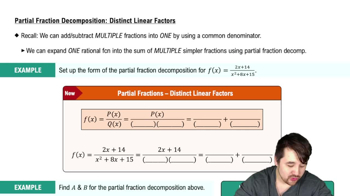
Use partial fraction decomposition to break \( a_k \) into simpler fractions. Set \( \frac{1}{(k+6)(k+7)} = \frac{A}{k+6} + \frac{B}{k+7} \) and solve for constants \( A \) and \( B \).
After finding \( A \) and \( B \), rewrite \( a_k \) as \( \frac{A}{k+6} + \frac{B}{k+7} \). This will help identify terms that cancel out when summing.
Write the partial sum \( S_n = \sum_{k=1}^n a_k \) by substituting the decomposed form of \( a_k \). Observe how most terms cancel out (telescope), leaving only a few terms from the beginning and end.
Express \( S_n \) explicitly in terms of \( n \), then evaluate the limit \( \lim_{n \to \infty} S_n \) to determine whether the series converges and find its sum if it does.
Verified video answer for a similar problem:
This video solution was recommended by our tutors as helpful for the problem above
Video duration:
4m
Play a video:
0 Comments
Key Concepts
Here are the essential concepts you must grasp in order to answer the question correctly.
Telescoping Series
A telescoping series is a series whose partial sums simplify by canceling intermediate terms, leaving only a few terms from the beginning and end. This simplification makes it easier to find a formula for the nth partial sum and analyze convergence.
Partial fraction decomposition breaks a complex rational expression into simpler fractions. For series like 1/((k+6)(k+7)), this technique helps rewrite terms so that the series telescopes, enabling easier summation and limit evaluation.
Partial Fraction Decomposition: Distinct Linear Factors
Limit of Partial Sums and Convergence
The sum of an infinite series is the limit of its partial sums as n approaches infinity. If this limit exists and is finite, the series converges; otherwise, it diverges. Evaluating this limit determines the series' value or divergence.