Vertical tangent lines If a function f is continuous at a and lim x→a| f′(x)|=∞, then the curve y=f(x) has a vertical tangent line at a, and the equation of the tangent line is x=a. If a is an endpoint of a domain, then the appropriate one-sided derivative (Exercises 71–72) is used. Use this information to answer the following questions. Graph the following curves and determine the location of any vertical tangent lines. a. x²+y² = 9
Verified step by step guidance
1
First, recognize that the given equation x² + y² = 9 represents a circle centered at the origin with a radius of 3.
To find vertical tangent lines, we need to express y as a function of x. Rearrange the equation to solve for y: y = ±√(9 - x²).
Differentiate y with respect to x to find the derivative y'. For y = √(9 - x²), use the chain rule: y' = (1/2)(9 - x²)^(-1/2) * (-2x). Simplify to get y' = -x / √(9 - x²).
Consider the limit of |y'| as x approaches the endpoints of the domain of y. The domain of y is -3 ≤ x ≤ 3. Check the behavior of y' as x approaches ±3.
As x approaches ±3, the denominator √(9 - x²) approaches 0, causing |y'| to approach infinity. This indicates vertical tangent lines at the points where x = ±3.
Verified video answer for a similar problem:
This video solution was recommended by our tutors as helpful for the problem above
Video duration:
8m
Play a video:
0 Comments
Key Concepts
Here are the essential concepts you must grasp in order to answer the question correctly.
Vertical Tangent Lines
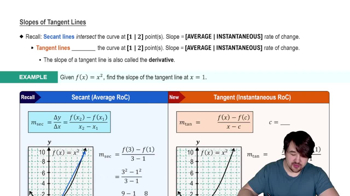
A vertical tangent line occurs at a point on a curve where the slope of the tangent approaches infinity. This typically indicates that the function is increasing or decreasing without bound at that point. In calculus, this is identified when the derivative of the function becomes undefined or approaches infinity, suggesting a steep incline or decline.
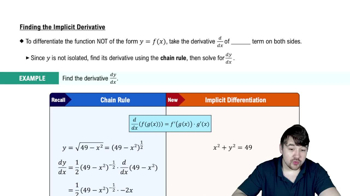
Implicit differentiation is a technique used to find the derivative of a function defined implicitly by an equation, rather than explicitly as y = f(x). This method involves differentiating both sides of the equation with respect to x and solving for dy/dx. It is particularly useful for curves defined by equations like x² + y² = 9, where y cannot be easily isolated.
Endpoints of a domain refer to the boundaries of the interval in which a function is defined. At these points, the behavior of the function may differ from that in the interior of the interval. One-sided derivatives are used to analyze the slope of the function from one direction (left or right) at these endpoints, which is crucial for determining the existence of vertical tangents in such cases.

 8:34 minutes
 Verified step by step guidance
 05:13
05:13