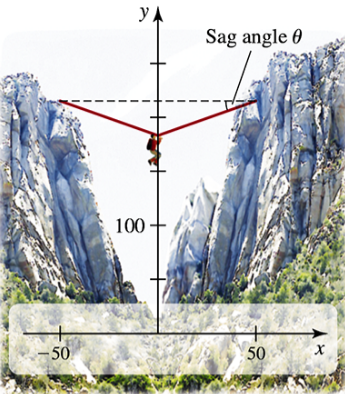
Sag angle Imagine a climber clipping onto the rope described in Example 7 and pulling himself to the rope’s midpoint. Because the rope is supporting the weight of the climber, it no longer takes the shape of the catenary y = 200 cosh x/200. Instead, the rope (nearly) forms two sides of an isosceles triangle. Compute the sag angle θ illustrated in the figure, assuming the rope does not stretch when weighted. Recall from Example 7 that the length of the rope is 101 ft.
Verified step by step guidance
1
Identify the key elements of the problem: The rope forms two equal sides of an isosceles triangle with the climber at the midpoint, the horizontal distance between the two cliffs is 100 ft (from -50 to 50 on the x-axis), and the total length of the rope is 101 ft.
Since the rope forms two equal sides, each side of the rope has length \( \frac{101}{2} = 50.5 \) ft.
Use the right triangle formed by half the horizontal distance (50 ft), the vertical sag (unknown), and the rope length (50.5 ft) as the hypotenuse to find the sag angle \( \theta \).
Apply the cosine definition for the sag angle \( \theta \):
\[ \cos \theta = \frac{\text{adjacent side}}{\text{hypotenuse}} = \frac{50}{50.5} \]
Solve for \( \theta \) by taking the inverse cosine (arccos) of the ratio:
\[ \theta = \arccos \left( \frac{50}{50.5} \right) \]
Verified video answer for a similar problem:
This video solution was recommended by our tutors as helpful for the problem above
Video duration:
4m
Play a video:
0 Comments
Key Concepts
Here are the essential concepts you must grasp in order to answer the question correctly.
Isosceles Triangle Geometry
An isosceles triangle has two sides of equal length and two equal angles opposite those sides. In this problem, the rope forms two equal segments from the midpoint to each cliff, creating an isosceles triangle. Understanding the properties of isosceles triangles helps relate the rope length and horizontal distance to the sag angle θ.
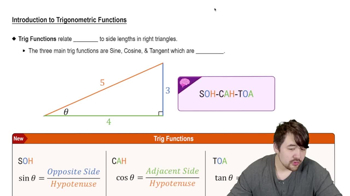
Trigonometry connects angles and side lengths in triangles using functions like sine, cosine, and tangent. To find the sag angle θ, one can use the cosine or sine function with known side lengths (half the horizontal distance and half the rope length). This allows calculation of θ from the triangle formed by the rope and the horizontal span.
The rope length is fixed at 101 ft and does not stretch, so the total length equals the sum of the two equal rope segments. This constraint is essential to relate the rope length to the horizontal distance between cliffs and the vertical sag, enabling calculation of the sag angle θ by applying the triangle side length relationships.