Explain why or why not Determine whether the following statements are true and give an explanation or counterexample.
c. If lim (as k → ∞) ᵏ√|aₖ| = 1/4, then ∑ 10aₖ converges absolutely.
Verified step by step guidance
1
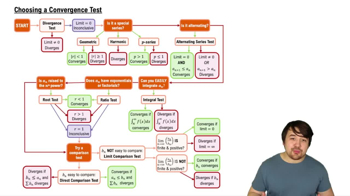
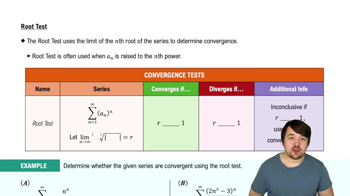
Recall the root test for series convergence: For a series \( \sum a_k \), if \( L = \lim_{k \to \infty} \sqrt[k]{|a_k|} \), then the series converges absolutely if \( L < 1 \), diverges if \( L > 1 \), and the test is inconclusive if \( L = 1 \).
Given \( \lim_{k \to \infty} \sqrt[k]{|a_k|} = \frac{1}{4} \), which is less than 1, the series \( \sum a_k \) converges absolutely by the root test.
Now consider the series \( \sum 10 a_k \). Since multiplying each term by a constant factor (here 10) does not affect the root limit except by a constant factor inside the root, analyze \( \sqrt[k]{|10 a_k|} \).
Note that \( \sqrt[k]{|10 a_k|} = \sqrt[k]{10} \cdot \sqrt[k]{|a_k|} \). As \( k \to \infty \), \( \sqrt[k]{10} \to 1 \), so the limit remains \( \frac{1}{4} \times 1 = \frac{1}{4} \).
Since the root limit for \( 10 a_k \) is also \( \frac{1}{4} < 1 \), the series \( \sum 10 a_k \) converges absolutely by the root test.
Verified video answer for a similar problem:
This video solution was recommended by our tutors as helpful for the problem above
Video duration:
2m
Play a video:
0 Comments
Key Concepts
Here are the essential concepts you must grasp in order to answer the question correctly.
Root Test for Series Convergence
The root test determines the convergence of a series by examining the limit of the k-th root of the absolute value of its terms. If this limit is less than 1, the series converges absolutely; if greater than 1, it diverges; and if equal to 1, the test is inconclusive.
A series ∑aₖ converges absolutely if the series of absolute values ∑|aₖ| converges. Absolute convergence guarantees convergence regardless of the signs of the terms, making it a stronger form of convergence.
Multiplying each term of a series by a constant factor scales the terms but does not affect the convergence nature if the constant is finite. Specifically, if ∑aₖ converges absolutely, then ∑c·aₖ also converges absolutely for any finite constant c.