87. Explain why or why not Determine whether the following statements are true and give an explanation or counterexample. d. If ∫(from 1 to ∞) x^(-p) dx exists, then ∫(from 1 to ∞) x^(-q) dx exists (where q > p).
Verified step by step guidance
1
Recall the integral in question is an improper integral of the form \(\int_1^{\infty} x^{-p} \, dx\). The convergence of this integral depends on the value of the exponent \(p\).
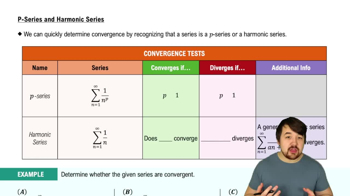
Determine the condition for convergence of \(\int_1^{\infty} x^{-p} \, dx\). This integral converges if and only if \(p > 1\). This is because the antiderivative is \(\frac{x^{-p+1}}{-p+1}\), and the limit as \(x \to \infty\) exists only when \(-p + 1 < 0\), or equivalently \(p > 1\).
Given that \(\int_1^{\infty} x^{-p} \, dx\) exists (converges), we know \(p > 1\). Now consider \(q > p\). Since \(q\) is greater than \(p\) and \(p > 1\), it follows that \(q > 1\) as well.
Because \(q > 1\), the integral \(\int_1^{\infty} x^{-q} \, dx\) also converges by the same reasoning as for \(p\). Thus, if the integral converges for \(p\), it must also converge for any \(q > p\).
Therefore, the statement is true: if \(\int_1^{\infty} x^{-p} \, dx\) exists, then \(\int_1^{\infty} x^{-q} \, dx\) exists for all \(q > p\).
Verified video answer for a similar problem:
This video solution was recommended by our tutors as helpful for the problem above
Video duration:
1m
Play a video:
0 Comments
Key Concepts
Here are the essential concepts you must grasp in order to answer the question correctly.
Improper Integrals and Convergence
Improper integrals extend the concept of definite integrals to infinite intervals or unbounded functions. Convergence means the integral approaches a finite value as the limit approaches infinity. Determining convergence often involves comparing the integrand's behavior at infinity.
The integral ∫₁^∞ x^(-p) dx converges if and only if p > 1. This is a fundamental result used to test convergence of integrals and series with power functions. It helps determine whether the area under the curve is finite over an infinite interval.
For power functions x^(-p), a larger exponent p means the function decreases faster as x → ∞. If the integral converges for some p, it will also converge for any q > p because x^(-q) decays faster, ensuring the integral's convergence.