81. Possible and impossible integrals Let Iₙ = ∫ xⁿ e⁻ˣ² dx, where n is a nonnegative integer. d. Show that, in general, if n is odd, then Iₙ = -½ e⁻ˣ² pₙ₋₁(x), where pₙ₋₁ is a polynomial of degree n - 1.
Verified step by step guidance
1
Start with the integral definition: \(I_n = \int x^n e^{-x^2} \, dx\), where \(n\) is a nonnegative integer and \(n\) is odd in this case.
Use integration by parts. Let \(u = x^{n-1}\) and \(dv = x e^{-x^2} \, dx\). Then compute \(du = (n-1) x^{n-2} \, dx\) and find \(v\) by integrating \(dv\).
Note that \(\int x e^{-x^2} \, dx = -\frac{1}{2} e^{-x^2}\), so \(v = -\frac{1}{2} e^{-x^2}\).
Apply integration by parts formula: \(I_n = u v - \int v \, du = -\frac{1}{2} x^{n-1} e^{-x^2} + \frac{n-1}{2} \int x^{n-2} e^{-x^2} \, dx\).
Recognize that the remaining integral is \(I_{n-2}\), so express \(I_n\) in terms of \(I_{n-2}\) and a polynomial term multiplied by \(e^{-x^2}\). Repeating this process reduces the integral to a sum of terms involving \(e^{-x^2}\) times polynomials of degree decreasing by 2, ultimately showing \(I_n = -\frac{1}{2} e^{-x^2} p_{n-1}(x)\) where \(p_{n-1}\) is a polynomial of degree \(n-1\).
Verified video answer for a similar problem:
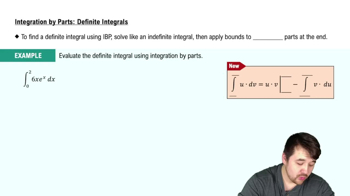
This video solution was recommended by our tutors as helpful for the problem above
Video duration:
4m
Play a video:
0 Comments
Key Concepts
Here are the essential concepts you must grasp in order to answer the question correctly.
Integration by Parts
Integration by parts is a technique derived from the product rule of differentiation. It transforms the integral of a product of functions into simpler integrals, often reducing the power of polynomials or simplifying exponential terms. This method is essential for evaluating integrals like Iₙ = ∫ xⁿ e⁻ˣ² dx, especially when n is a nonnegative integer.
The exponential function e⁻ˣ² has unique properties, including its derivative being proportional to x e⁻ˣ². Understanding how differentiation and integration affect e⁻ˣ² is crucial for manipulating integrals involving this term. This knowledge helps in expressing integrals in terms of polynomials multiplied by e⁻ˣ².
Certain integrals involving polynomials and exponential functions can be expressed as a product of an exponential function and a polynomial. For odd n, the integral Iₙ can be represented as -½ e⁻ˣ² times a polynomial pₙ₋₁(x) of degree n - 1. Recognizing this form aids in proving the general expression and understanding the structure of the solution.